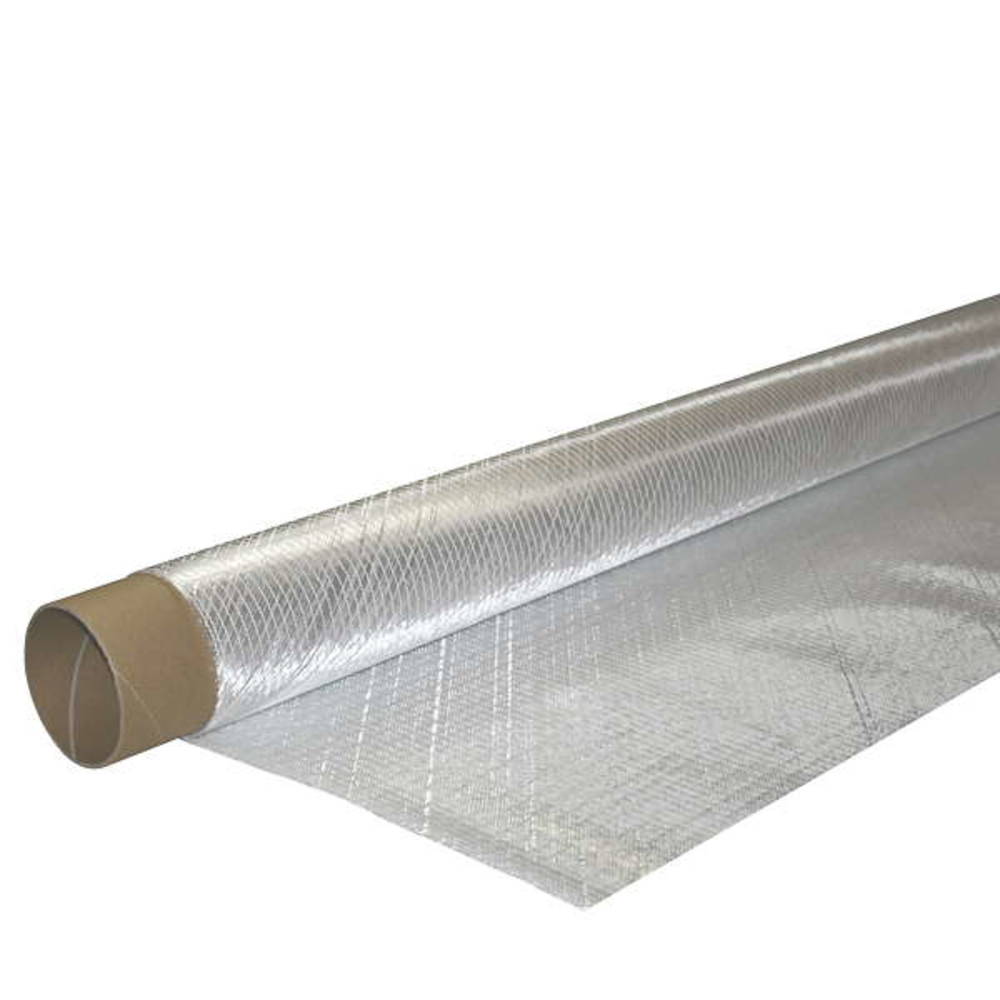
Biaxial glass non-crimp fabric with pronounced ±45° reinforcement – ideal for lightweight, load-oriented GFRP structures subjected to shear and torsional loads.
The 340 g/m² reinforcement combines two substantial E-glass fibre layers at −45° and +45° with lightweight stabilising 0° and 90° layers. The fibres are stitched rather than woven, allowing the primary reinforcement fibres to remain largely straight and work efficiently in their defined directions. The generous 127 cm width also enables large continuous cut pieces with fewer overlaps.
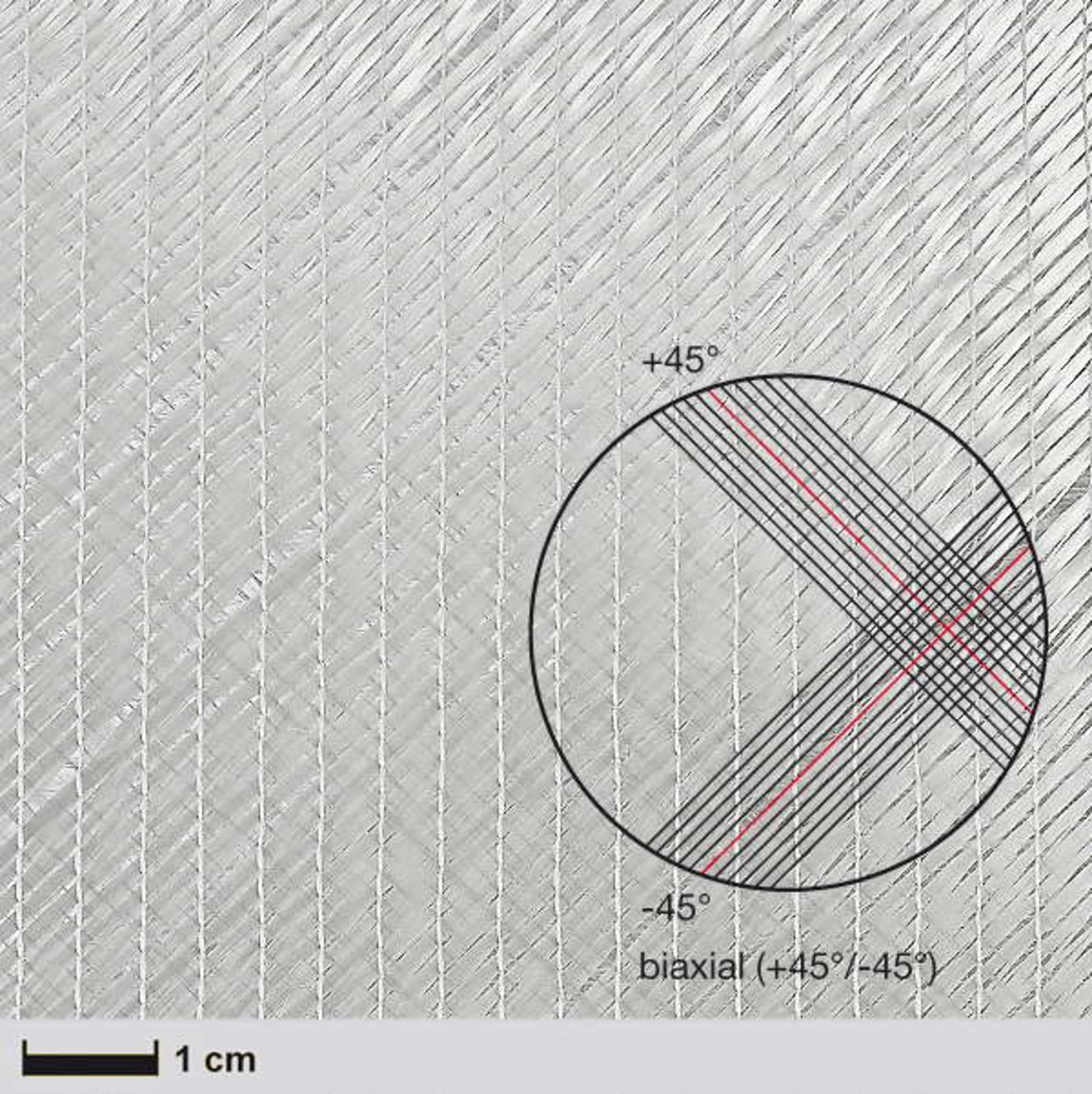
This multiaxial E-glass non-crimp fabric is specifically designed around a pronounced ±45° fibre orientation. Of the total 339 g/m² of glass reinforcement, 156 g/m² is positioned in each of the −45° and +45° directions. A total of 312 g/m² therefore lies in the two primary diagonal reinforcement directions.
The additional 0° and 90° layers, at only 4 and 23 g/m² respectively, are deliberately lightweight. They stabilise the non-crimp fabric construction and improve handling without significantly changing the characteristic ±45° reinforcement concept.
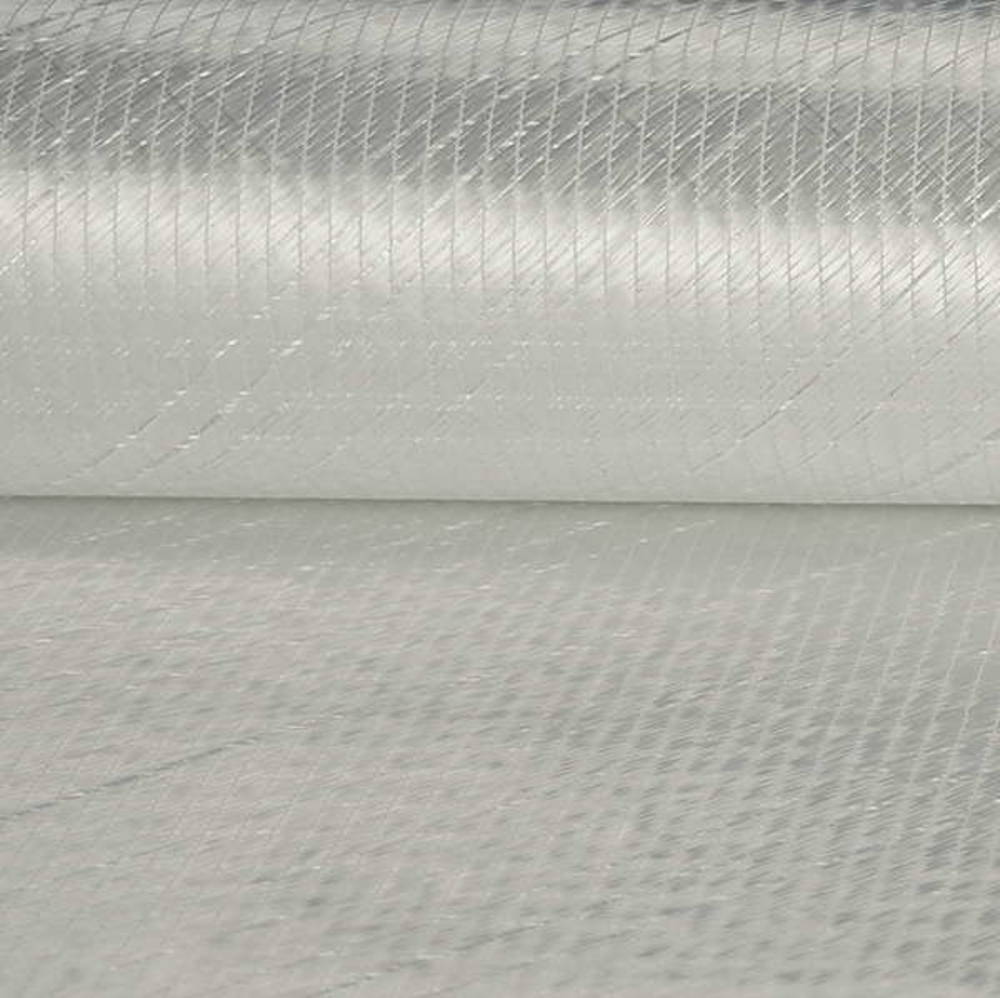
Because the fibre layers are stitched rather than interwoven, the primary reinforcement layers do not contain the yarn intersections and crimp characteristic of conventional woven fabrics. This allows a more direct, load-oriented fibre path and makes the reinforcement particularly attractive for modern lightweight composite structures.
| Fibre type | E-glass |
| Construction | multiaxial stitched glass non-crimp fabric |
| Nominal designation | 340 g/m² biaxial ±45° |
| Total areal weight | 346 g/m² ± 5% |
| 1st layer −45° | 156 g/m², 136 tex |
| 2nd layer 0° | 4 g/m², 68 tex |
| 3rd layer 90° | 23 g/m², 68 tex |
| 4th layer +45° | 156 g/m², 136 tex |
| Stitching thread | Polyester, ≤ 7 g/m² |
| Layer bonding | stitched |
| Sizing | multicompatible / silane |
| Width | 127 cm ± 1.9% |
Benefits of the Non-Crimp Fabric
- 312 g/m² of glass reinforcement concentrated in the primary ±45° directions
- straight fibre alignment without conventional woven yarn intersections
- ideal for laminate lay-ups subjected to shear and torsional loading
- lightweight 0° and 90° layers stabilise the reinforcement
- good conformity to curved and three-dimensional component geometries
- efficient, load-oriented laminate design
- 127 cm width for large cut pieces and fewer overlaps
Applications
Biaxial ±45° non-crimp fabrics provide an efficient reinforcement solution for components where shear forces, torsional loads or diagonal load paths play an important role. The two substantial ±45° layers provide the predominant reinforcement function.
For load-oriented laminate design, the material can be combined effectively with 0°, 90° or unidirectional reinforcement layers. This allows the fibre architecture to be tailored to the actual loads acting on the component.
Typical applications:
- boat and yacht construction
- automotive and motorsport components
- pipes and profiles
- torsion-loaded components
- rotor, wing and blade structures
- sports equipment
- sandwich constructions
- technical GFRP and hybrid laminates
Suitable Resin Systems
The multicompatible sizing allows the reinforcement to be processed with suitable epoxy, polyester and vinyl ester laminating resins, providing flexibility for a wide range of component and processing requirements.
For high-quality laminates, a laminating resin with suitable flow characteristics is recommended to achieve uniform wet-out of all fibre layers. Careful consolidation supports a homogeneous laminate structure and helps minimise trapped air between reinforcement plies.
Calculated Data for Hand Lay-Up Laminates with 35 Vol.-% Fibre Content
| Resin consumption | approx. 279 g/m² |
| Laminate thickness | approx. 0.370 mm |
| Laminate weight | approx. 619 g/m² |
Benefits of the 127 cm Width
At 127 cm wide, the reinforcement is particularly attractive for larger components. Shells, panels, sandwich structures and other large surfaces can be covered with larger continuous cut pieces. Fewer joints and overlap areas simplify laminate lay-up and support more uniform fibre placement.
Technical Notes
Why biaxial ±45°?
The construction contains four fibre layers at −45°, 0°, 90° and +45°. The two ±45° layers contain 156 g/m² each and therefore account for 312 g/m² of the total glass reinforcement. The lightweight 0° and 90° layers stabilise the stitched construction. The designation “biaxial ±45°” therefore accurately describes the principal structural reinforcement directions.
Straight fibre orientation
Because the fibre layers are stitched rather than woven together, the reinforcing fibres can remain largely straight in their defined orientations. This allows the glass fibres to be used efficiently within a load-oriented laminate design.
Shear and torsional loads
±45° fibre layers are particularly effective in laminate constructions designed to transfer shear stresses and torsional loads. Combined with additional 0°, 90° or UD reinforcement, they allow high-performance laminate architectures to be tailored to the specific component loads.
Processing
The non-crimp fabric can be used in hand lay-up as well as suitable vacuum-assisted processing methods. Its stitched construction helps maintain the defined fibre orientation during careful cutting, handling and positioning.












 MSDS Glass fabric, tapes, braided sleeves, rovings, yarns, chopped strands (PDF)