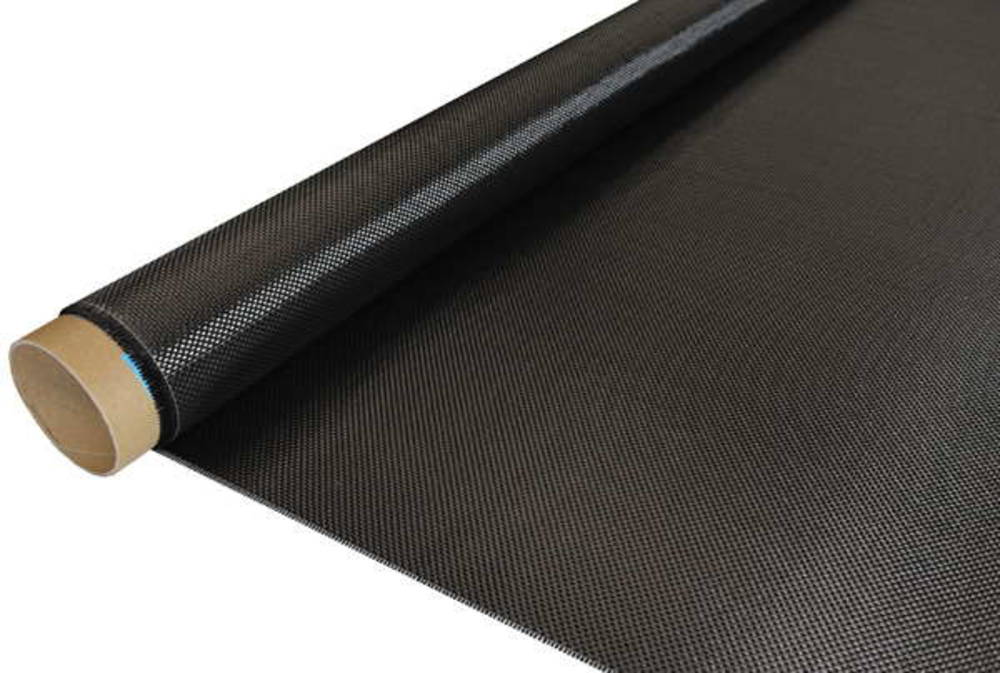
200 g/m² carbon fabric made from high-strength 3k carbon fibres in a plain weave, 125 cm wide.
Dimensionally stable reinforcement fabric for large CFRP components, structurally stable laminates and uniform visible carbon finishes.
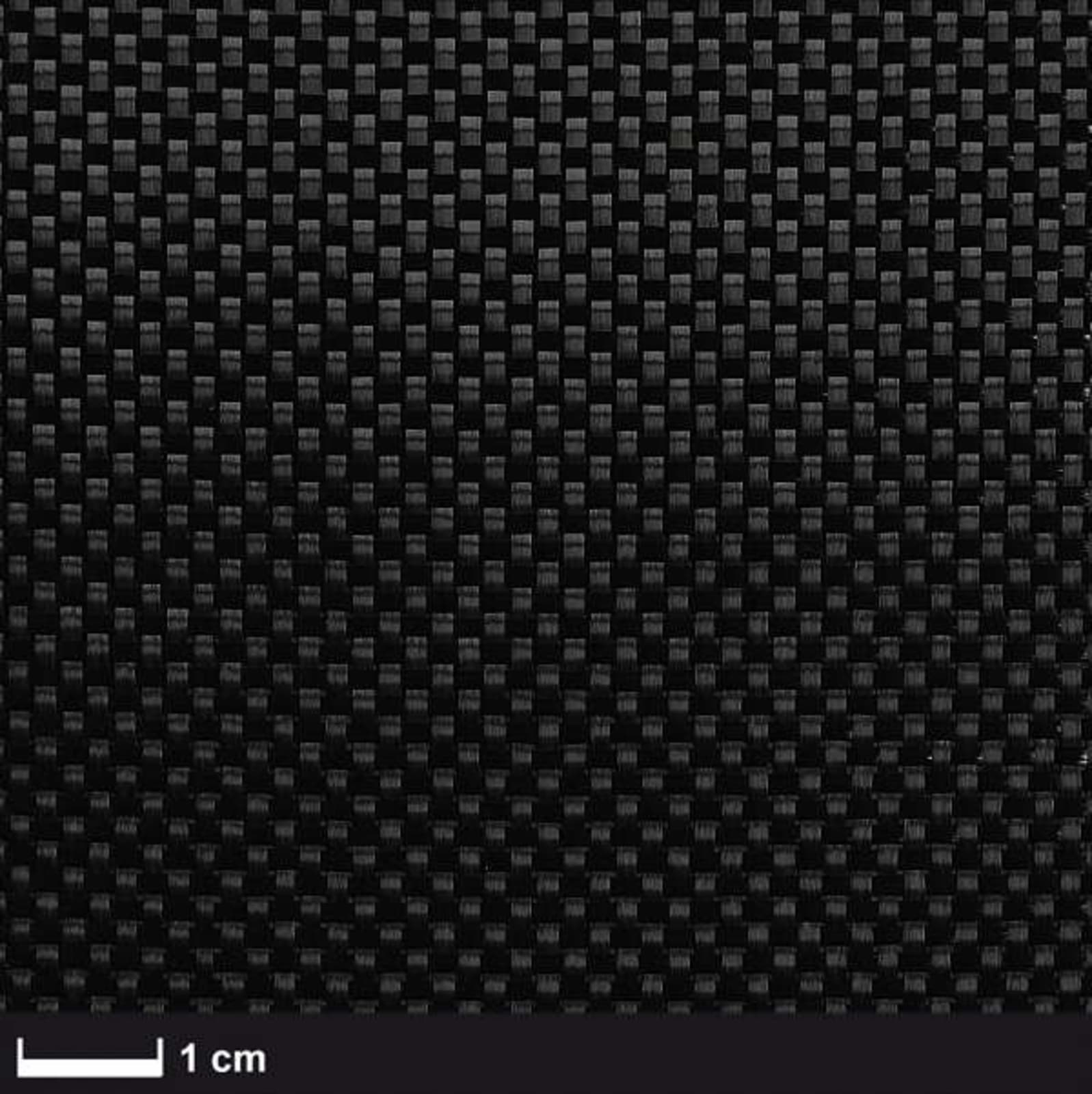
The balanced plain weave with 5 ends/cm in both warp and weft provides good resistance to yarn displacement and uniform fibre distribution. The fabric can be cut and positioned accurately. Its 125 cm width allows larger continuous cut pieces and can reduce the number of fabric joints where component dimensions permit.
Technical data
| Fibre type |
High-strength carbon fibre (HT, 3k) |
| Yarn linear density |
200 tex (3,000 filaments) |
| Areal weight |
200 g/m² |
| Weave |
Plain 1/1 |
| Warp / weft count |
5.0 / 5.0 ends/cm |
| Fabric width |
125 cm |
| Area per linear metre |
1.25 m² |
| Fibre tensile strength |
4,000 MPa |
| Fibre tensile modulus |
230 GPa |
| Fibre elongation at break |
1.7% |
| Fibre test method |
ISO 10618 |
| Resin compatibility |
Epoxy, vinyl ester and polyester resins |
Typical applications
- Large CFRP shells, covers and technical fairings
- Flat and gently curved sandwich skins
- Body panels, structural panels and air ducts for motorsport and automotive applications
- Drone, UAV and model aircraft components
- Boatbuilding, sports equipment and composite tooling
- Technical housings, prosthetic laminates and visible carbon parts
Properties and processing
The frequent yarn interlacings of the plain weave provide comparatively good resistance to yarn displacement. Fibre alignment remains easy to control during cutting, positioning and multi-ply lay-ups. At 200 g/m², the fabric allows the required laminate thickness to be built up efficiently, with balanced reinforcement in both principal fibre directions.
The fabric can be processed with suitable epoxy, vinyl ester and polyester laminating resin systems. Epoxy resin systems are generally preferred for mechanically demanding CFRP laminates. Ensure complete fibre wet-out and careful air removal. Drapability is limited around tight radii and complex double-curved surfaces compared with twill fabrics. The stated mechanical properties refer to the carbon fibres, not to the finished laminate.
Material selection
For smaller cut pieces, the same plain-weave fabric in a 100 cm width (CT-200100P) is available. For more strongly curved components, the 200 g/m² twill-weave carbon fabric (CT-200125T) offers better drapability, while the plain weave provides greater resistance to yarn displacement and more accurate fibre positioning.
Calculated laminate data for hand lay-ups with 35% fibre volume fraction
| Calculated resin requirement |
approx. 241 g/m² |
| Calculated laminate thickness |
approx. 0.32 mm |
| Calculated laminate areal weight |
approx. 441 g/m² |












 MSDS Carbon fabrics (all) (PDF)