Produce forged carbon components and technical moulding compounds with a versatile carbon fibre cut length.
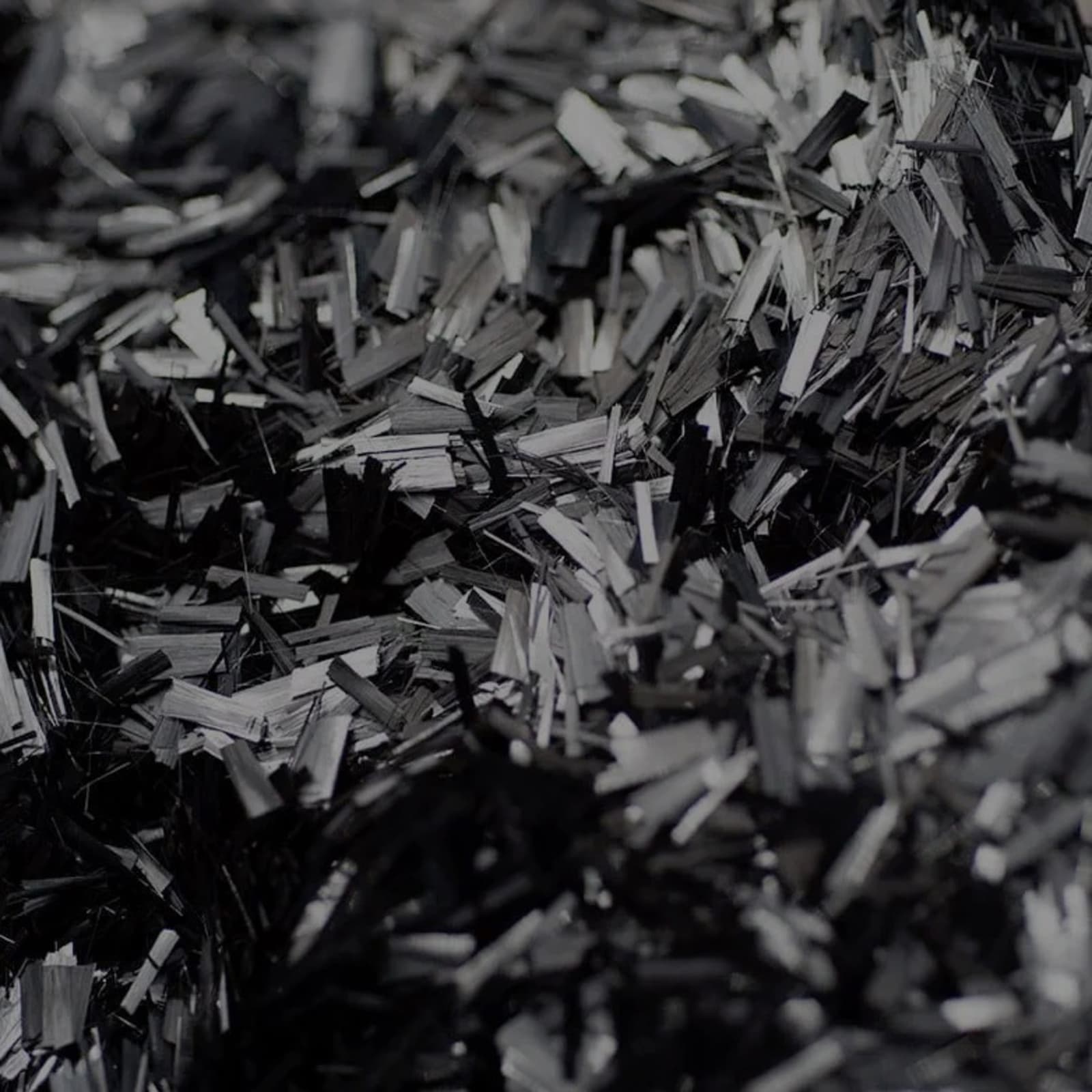
These 6 mm chopped carbon fibres combine an intermediate fibre length with comparatively good distribution characteristics in suitable resin systems. They are intended for fibre-reinforced moulding compounds, compression-moulded carbon parts and technical fillers. For components with varying contours, this cut length provides a practical balance between the processability of shorter fibres and the use of longer fibre segments.
These chopped carbon fibres are produced from recycled carbon fibre feedstock containing different high-tensile (HT) fibre grades, using a dry precision-cutting process. The manufacturer processes various source tow sizes, including 3K, 6K, 12K, 24K, 48K and 50K. The material is not restricted to a single tow size or fibre grade, and its composition may vary between production batches.
The 6 mm fibre segments can be incorporated into suitable thermosetting resin systems to produce short-fibre-reinforced compounds. In forged carbon manufacturing, the fibres are mixed with resin to form a mouldable compound or wetted out directly inside a mould before consolidation. Unlike woven reinforcements, this process does not produce a precisely defined fibre orientation. The final properties depend on fibre distribution, resin content, moulding conditions and cure schedule.
Technical Data
| Fibre type |
Recycled HT carbon fibres from different sources |
| Nominal cut length |
6 mm |
| Source tow sizes |
3K, 6K, 12K, 24K, 48K and 50K; mixing ratio not specified |
| Individual filament diameter |
Approx. 7 µm, indicative value |
| Fibre density |
Approx. 1.7 g/cm³, previously published product reference value |
| Sizing content |
Approx. 1.4%, indicative value; sizing type and content may vary |
| Tensile strength of source fibres |
Approx. 3,500 MPa, reference value |
| Tensile modulus of source fibres |
Approx. 230 GPa, reference value |
| Elongation at break of source fibres |
Approx. 1.5%, reference value |
| Compatible matrix systems |
Epoxy, polyester and vinyl ester resins; application-specific compatibility testing required |
The mechanical fibre properties are based on the manufacturer's reference values corresponding to Toray T300. Because different HT fibre grades are blended, these values do not represent guaranteed properties of every individual fibre or production batch. They must not be used directly as tensile strength or stiffness values for the finished composite.
Properties and Benefits
The intermediate cut length makes these chopped carbon fibres a versatile option for moulding compounds and forged carbon components. Compared with 3 mm fibres, longer fibre segments are available, while the 6 mm grade may be easier to distribute than the 12 mm version in appropriately sized component geometries.
In a properly wetted-out and consolidated resin matrix, the fibres can contribute to mechanical reinforcement. Actual performance depends on fibre orientation, fibre-matrix adhesion, fibre volume fraction and void content. Increasing the fibre loading does not necessarily result in better composite properties.
As carbon fibres are electrically conductive, the chopped fibres can also be incorporated into electrically conductive resin formulations. Whether a continuous conductive network develops must be verified through suitable testing.
Applications in Moulding Compounds and Forged Carbon
A typical application is the production of forged carbon parts in matched moulds. The chopped fibres are combined with a suitable resin matrix and consolidated under pressure. Their irregular orientation creates the distinctive, non-uniform carbon appearance associated with forged carbon composites.
Further applications include technical compression-moulded components, short-fibre-reinforced filler compounds, fibre-filled adhesive and casting systems, and complex component areas where continuous fabric reinforcement may be difficult to position or process.
For applications requiring directional reinforcement, short-fibre regions can be combined with carbon fibre fabrics or non-crimp fabrics. However, chopped fibres do not replace a properly designed continuous-fibre reinforcement lay-up.
Processing and Consolidation
To prepare a moulding compound, first mix the resin system according to the manufacturer's instructions. For two-component systems, thoroughly combine resin and hardener at the specified ratio. Then incorporate the chopped carbon fibres gradually until a consistency suitable for the intended moulding process is achieved.
For forged carbon parts, introduce the fibre-filled compound into a mould prepared with a suitable release agent. Uniform distribution and adequate consolidation are essential to minimise dry areas, local fibre accumulation and voids. Higher fibre loading generally increases processing demands and may significantly alter the flow behaviour of the compound.
Alternatively, the chopped fibres can be applied to areas already wetted with resin. In this case, ensure complete fibre wet-out. Resin consumption, working time, processing temperature and curing conditions depend on the selected resin system.
Which Cut Length Should You Choose?
The 6 mm grade is suitable for users looking for a versatile short-fibre reinforcement for moulding compounds and medium-sized components. Where small details or finer coatings are the priority, 3 mm chopped carbon fibres may be more suitable. For larger sections and appropriate mould geometries, 12 mm chopped carbon fibres can also be considered.
Frequently Asked Questions (FAQ)
How much chopped carbon fibre should be added to an epoxy resin?
There is no universally applicable loading level. The appropriate amount depends on resin viscosity, fibre distribution, component geometry and processing method. Start with a trial formulation that remains easy to process and adjust the fibre content gradually.
Is forged carbon as strong as a woven carbon fibre laminate?
Not necessarily. Woven laminates allow fibre orientation and ply sequence to be controlled, whereas short-fibre composites have a different reinforcement distribution. Both manufacturing methods can produce suitable components, but each requires an appropriate design approach and validation.
Is the width of the chopped fibre bundles consistent?
No. The source material includes tow sizes ranging from 3K to 50K. As a result, bundle widths may differ even when the cut length is identical, and batch-to-batch variation is possible.
Storage and Safety
Store the material in a dry environment protected from dust and contamination after opening. Take suitable precautions against fibre dust during mixing. Eye protection, gloves and appropriate respiratory protection should be used where required. Prevent loose carbon fibres from entering electrical equipment and electronic assemblies.












 MSDS Carbon fibre strands 3 mm (PDF)