Fine 225 g/m² chopped strand glass mat – ideal for thinner GFRP laminates, repairs and precisely controlled laminate build-up.
This powder-bound E-glass chopped strand mat is easy to cut, wets out readily and conforms well to component contours during laminating. With a calculated laminate thickness of approximately 0.58 mm per ply, it provides particularly good control over laminate thickness. The 127 cm width is suitable for both smaller repair areas and larger continuous cut pieces.
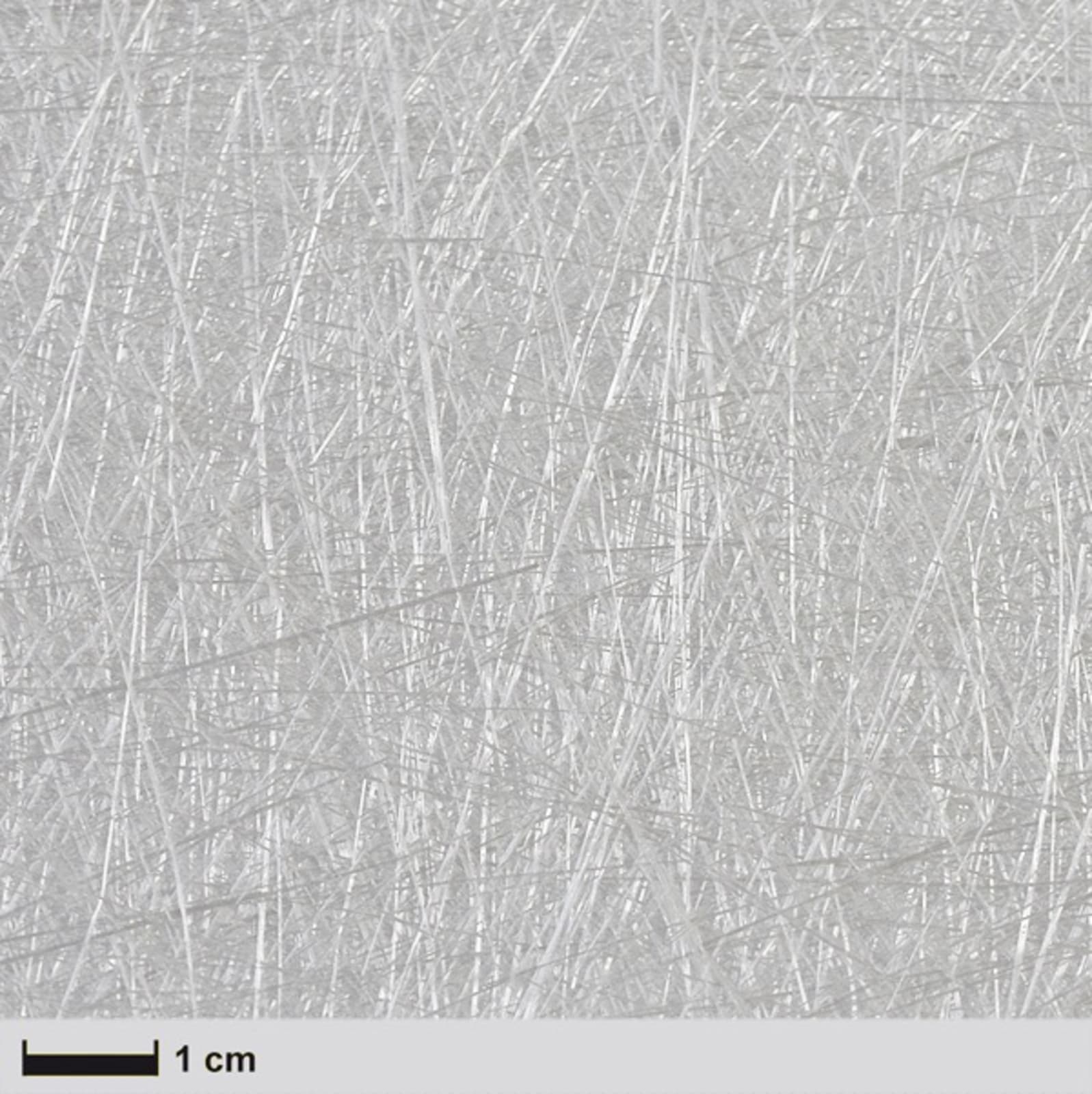
The glass-fibre mat consists of chopped E-glass fibres arranged randomly in the plane. This provides largely non-directional reinforcement within the laminate plane – an important advantage for components where no pronounced primary load direction is required.
At 225 g/m², this is the lightweight grade within the conventional chopped strand mat range. Each ply introduces a comparatively small amount of reinforcement, allowing the required laminate thickness to be built up in finely controlled increments. This is particularly useful for thin-walled mouldings, repairs, transition areas and smaller components.
The 50 mm long glass fibres are held together by a powder binder. During impregnation, the mat becomes soft and conformable, allowing it to adapt readily to curves, transitions and component contours.
| Fibre type | E-glass |
| Construction | chopped strand mat, powder-bound |
| Areal weight | 225 g/m² ± 5% |
| Fibre length | 50 ± 2 mm |
| Yarn fineness | 15 tex, split strands |
| Binder | polyester-based powder binder |
| Binder content | 4.7 ± 1% |
| Width | 127 cm |
Benefits of the Glass Mat
- light areal weight for finely controlled laminate thickness
- largely non-directional in-plane reinforcement
- good conformity to curves and component contours
- ideal for thin-walled components and repair areas
- straightforward processing by conventional hand lay-up
- 127 cm width for flexible cutting and lay-up
Applications
The 225 g/m² chopped strand mat is particularly suitable where laminate thickness needs to be built up in smaller, controlled increments. Its comparatively low areal weight makes it easy to conform to smaller radii and changing contours, making it especially practical for repair work.
Typical applications:
- small and thin-walled GFRP components
- repairs and local reinforcement
- mould and model construction
- fairings and covers
- boat and vehicle components
- pond and tank linings
- multi-ply GFRP laminate structures
Suitable Resin Systems
The powder-bound glass mat is particularly well suited to polyester and vinyl ester laminating resins. On contact with styrene-containing resin, the binder dissolves rapidly, allowing the mat to become soft and readily conformable.
Processing with suitable epoxy resin systems is also possible. As epoxy resins affect the powder binder differently from styrene-containing resin systems, the mat may retain its original structure for longer and may become less soft. This should be taken into account when laminating highly contoured components.
Calculated Data for Hand Lay-Up Laminates with 15 Vol.-% Fibre Content
| Resin consumption | approx. 563 g/m² |
| Laminate thickness per ply | approx. 0.58 mm |
| Laminate weight | approx. 788 g/m² |
These values are calculated guidelines. Actual resin consumption and laminate thickness depend on the resin system, processing method and degree of consolidation.
Which Glass Mat Should I Choose?
| Areal weight | Laminate thickness per ply* | Typical use |
| 225 g/m² | approx. 0.58 mm | thinner laminates, repairs and finely controlled laminate build-up |
| View chopped strand mat 300 g/m² → | approx. 0.77 mm | versatile standard grade for general laminating work |
| View chopped strand mat 450 g/m² → | approx. 1.15 mm | greater laminate thickness and faster material build-up with fewer plies |
* Calculated values at 15 vol.-% fibre content.
Benefits of the 127 cm Width
The 127 cm width provides excellent flexibility when cutting the material. Small repair patches can be cut economically, while larger components can be covered with wide continuous plies. This can reduce unnecessary joints and overlap areas.
Artistic and Decorative Applications
The characteristic random fibre structure of the chopped strand mat can also be deliberately used as a visible design feature. For transparent or decorative applications, we recommend the highly transparent Epoxy Resin HT 2 + Hardener HT 2 (Item No. 105100). It is particularly suitable where the characteristic glass-fibre structure is intended to remain visible beneath a clear resin matrix.
Processing Tips
Wet-out
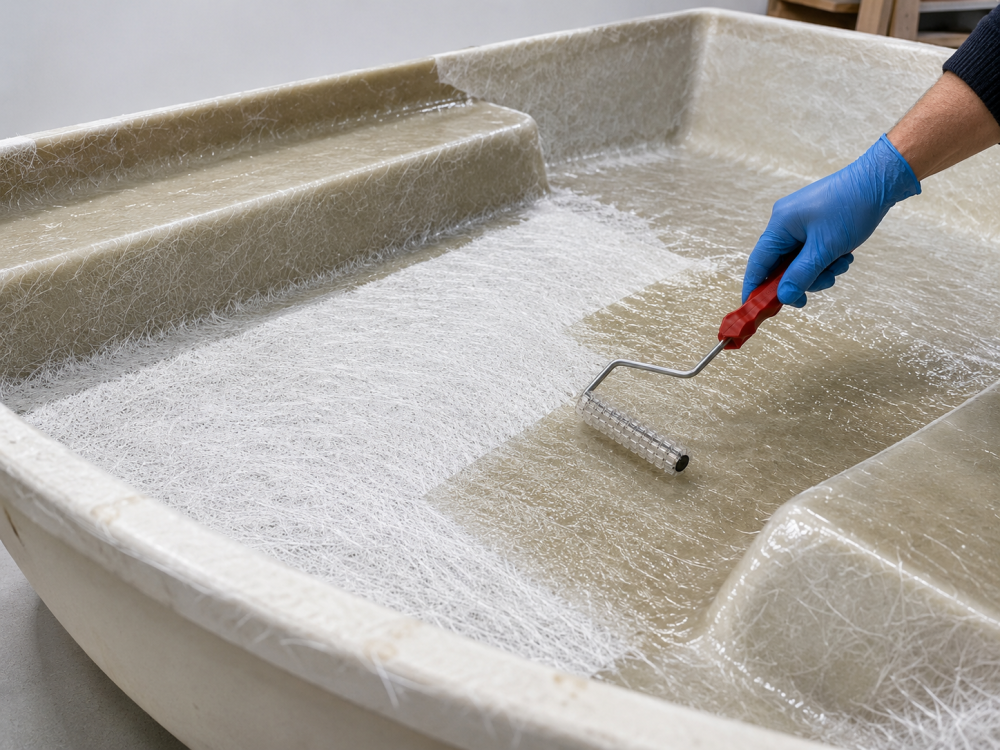
Apply the laminating resin evenly to the substrate first, place the pre-cut glass mat onto the wet surface and then fully impregnate it with resin. With polyester and vinyl ester resins, the powder-bound mat rapidly becomes soft and can be formed readily to the component geometry.
Consolidation
Carefully remove trapped air using a laminating brush or consolidation roller. The fibres should be completely wetted, while unnecessary excess resin should be avoided as it only increases laminate weight and resin consumption.
Multi-ply laminates
Several layers can be applied wet-on-wet. The lightweight 225 g/m² grade allows particularly fine control over the required laminate thickness and is also well suited to blending transitions and local reinforcement areas.












 MSDS Glass fabric, tapes, braided sleeves, rovings, yarns, chopped strands (PDF)