




Automotive Composites – Carbon Fiber and Fiberglass for Motorsport, Tuning and Special Vehicles
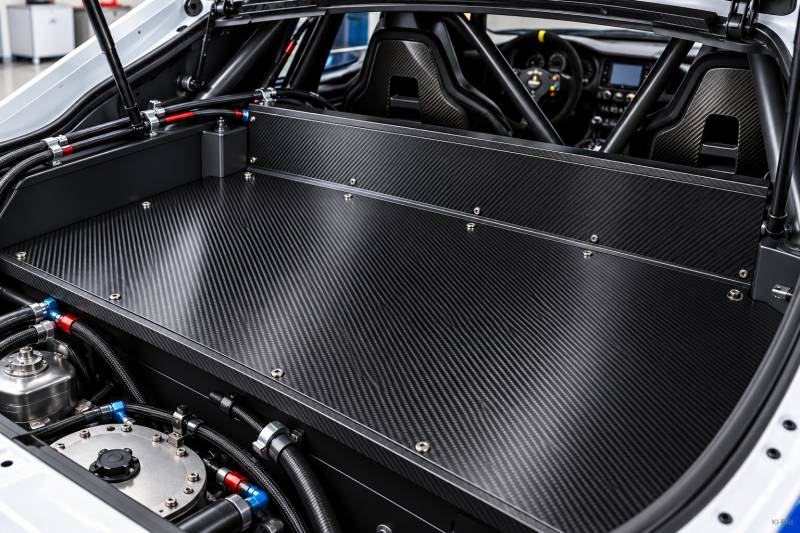
Weight, stiffness and surface quality are what count in vehicle construction. Automotive composites made of CFRP (carbon fiber reinforced plastic) and GFRP (glass fiber reinforced plastic) deliver all three and can be processed economically even in small quantities. R&G supplies prototype builders, motorsport teams, manufacturers of tuning parts and special vehicle builders with resin systems, carbon fiber fabrics, prepregs and semi-finished products. On request, we machine parts from CFRP sheets and tubes directly to your drawing.
Why Use Carbon Fiber and Fiberglass in Vehicle Construction?
Composites are now established in motorsport, sports car construction and special vehicle manufacturing. Compared with steel and aluminum, they offer clear advantages:
- Lightweight construction: Carbon parts are significantly lighter than metal parts at the same stiffness. This reduces consumption and improves driving dynamics.
- Design freedom: Panels, spoilers and body parts are produced in one piece, even with complex curves.
- Small quantities: Open molds with hand layup or vacuum bagging are economical even for prototypes and small series.
- Visual quality: Visible carbon parts add striking accents to the interior and bodywork.
TÜV-Recognized Laminate Layups
For add-on parts on road-registered vehicles in Germany, testing organizations such as TÜV (German technical inspection and certification organization) usually require proof of the laminate layup used. The tests include a ball drop test according to TA 29 (DIN 52306) and a test of horizontal burning behavior according to 95/28/EC Annex IV. R&G provides a sample approval for TÜV-compliant laminate layups as a free download. Details are explained in our wiki article on TÜV testing of laminate layups.
Laminate layups with Epoxy resin EPIKOTE™ LR 285 + Hardener EPIKURE™ LH 285 are recognized by TÜV. The low-viscosity laminating resin wets out glass, aramid and carbon fibers and is mixed at a ratio of 100 : 40 by weight. The working time is approx. 50 minutes. After 24 hours at room temperature, we recommend a post-cure for 15 hours at 55 °C.
Which Automotive Composites Do You Need?
Carbon Fiber Fabrics and Visible Carbon
For structural parts and visible surfaces, we offer carbon fiber fabrics in various weaves and weights. Spread tow fabrics (made of flat-spread fiber tows) from TeXtreme produce particularly thin laminates with a distinctive checkerboard pattern. How to achieve clean visible surfaces with them is described in our wiki article on TeXtreme carbon fabrics for visible parts. For impact-loaded areas such as underbody or wheel arch panels, carbon-aramid fabrics are suitable.
Prepregs for Motorsport and Small Series
Prepregs are fibers pre-impregnated with resin. They provide a precisely defined resin content and therefore reproducible, lightweight parts. In our carbon prepreg range, you will find SIGRAPREG® carbon fabric prepreg with 245 g/m², UD carbon prepreg and matching epoxy resin film. Prepregs cure under heat. Our wiki article on post-curing and heat curing gives advice on post-curing and building heated molds.
Forged Carbon
Forged carbon is made from short, chopped carbon fibers that are pressed into a mold together with resin. The result is a marble-like surface that is popular for tuning and design parts. We offer chopped carbon fibers in lengths of 3, 6 and 12 mm. Our article on forged carbon shows how the process works.
High-Temperature Resins for the Engine Compartment
For parts close to the engine and exhaust system, Epoxy resin MP Advanced + Hardener MP Advanced E is suitable. This high-temperature laminating resin is designed for temperatures above 200 °C and requires a stepped post-cure. Due to the German Chemicals Prohibition Ordinance, we only supply it to resellers, professional users and research and teaching institutions.
Mold Making
Many workshops build their own molds for body and trim parts. For this purpose, we offer mold resins such as Mold Resin P with Hardener P-25 as well as release agents and accessories.
CFRP Semi-Finished Products and CFRP Machining
For brackets, struts and interior parts, carbon fiber sheets from 0.2 to 6 mm thick and pultruded or wound carbon tubes are suitable. With our CFRP machining service, we produce parts from them to your drawing. We mill structural parts up to 2,200 x 900 x 30 mm and machine tubes up to 250 mm outer diameter. We also handle threaded inserts, bonding and painting, from a batch size of one. What matters when machining is described in our wiki article on machining CFRP parts.
Fiberglass for Special Vehicles and RVs
In special vehicle and RV construction, fiberglass is usually used, for example for panels, storage boxes and interior parts. GFRP sheets and glass fiber in the form of fabrics and mats for your own laminates are suitable for this.
Adhesives
Many composite parts are joined to metal or plastic components. For structural bonding, we offer adhesives. Tips on preparing the bonding surfaces can be found in our article on bonding carbon fiber semi-finished products.
Applications in Vehicle Construction
- Prototypes and small series: Body and trim parts from open molds, by hand layup, vacuum bagging or as prepreg.
- Motorsport and racing vehicles: Lightweight structural parts, aerodynamic parts and panels. R&G also supports student teams such as the TUfast Eco solar racing team of the Technical University of Munich, as shown in our customer projects.
- Tuning and design parts: Mirror caps, trims and interior parts in visible carbon or forged carbon.
- Special equipment and special vehicles: Panels, fittings and bodies made of fiberglass and carbon fiber for RVs and commercial vehicles.
- Motorcycles: Fairings and add-on parts, as the example of a carbon motorcycle fairing shows.
What Matters During Processing
- Mixing ratio: Weigh resin and hardener precisely by weight. Deviations reduce strength and temperature resistance.
- Post-cure: Post-curing according to the manufacturer's instructions increases heat resistance, for LR 285 around 15 hours at 55 °C.
- Visible surfaces: Cut carbon fabrics cleanly and avoid distortion. Our wiki article on slip-resistant fabrics for visible carbon parts gives advice.
- Material requirements: Plan layup and resin quantity in advance with the laminate calculator and the resin calculator.
- Occupational safety: Sanding and milling CFRP produces fine dust. Wear respiratory protection, safety goggles and gloves. You will find suitable equipment under Safety Equipment.
For questions about laminate layup, TÜV requirements or manufacturing processes, our technical consultancy will be happy to help.
FAQ – Frequently Asked Questions About Automotive Composites
Which epoxy resin is suitable for carbon parts in vehicle construction?
For structural parts, we recommend Epoxy resin EPIKOTE™ LR 285 with Hardener EPIKURE™ LH 285. Laminate layups with this system are recognized by TÜV. The resin has a low viscosity, wets out carbon fibers well and achieves high strength after post-curing.
Do add-on parts made of carbon fiber or fiberglass need TÜV testing?
In most cases, yes. For add-on parts on road-registered vehicles in Germany, the testing organization usually requires proof of the laminate layup, for example a ball drop test and a burning behavior test. R&G offers a sample approval for TÜV-compliant laminate layups as a free download. Clarify which tests are required in your specific case with your testing organization.
What is forged carbon?
Forged carbon consists of short chopped carbon fibers that are pressed into a mold together with resin. The randomly oriented fibers create a marble-like look. The process is particularly suitable for design and tuning parts with complex geometry.
When are prepregs worthwhile in vehicle construction?
Prepregs are worthwhile when weight and reproducibility are the priority, for example in motorsport or small series. The resin content is precisely defined, which makes the laminate light and uniform. Heat-resistant molds and curing at elevated temperature are required.
Which resin is suitable for parts in the engine compartment?
Epoxy resin MP Advanced is suitable for high service temperatures. It is a high-temperature resin designed for temperatures above 200 °C. The system is only supplied to professional users, resellers and research and teaching institutions.
Can R&G produce carbon parts to your drawing?
Yes. With our CFRP machining service, we mill parts from carbon and fiberglass sheets, tubes and sandwich materials to your specifications, from a batch size of one. Please send your inquiries to cfk@r-g.de.

