Detailed Description
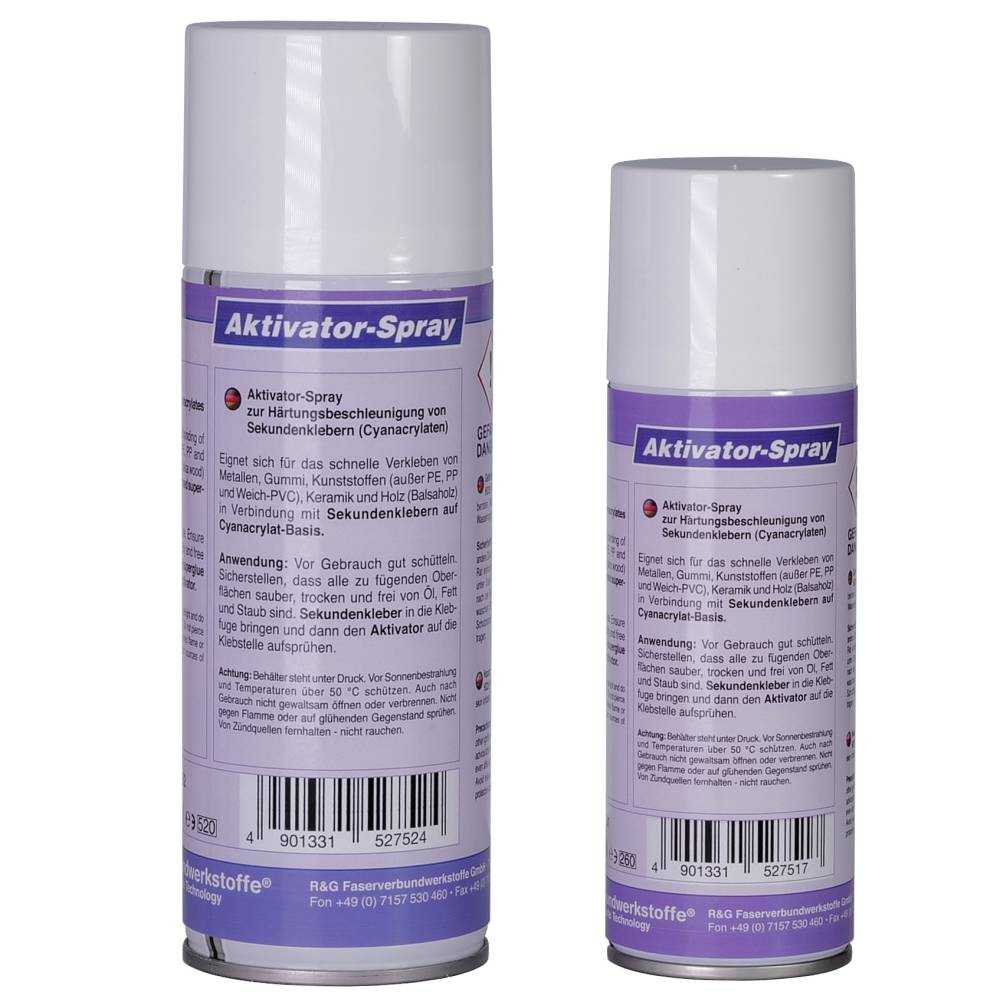
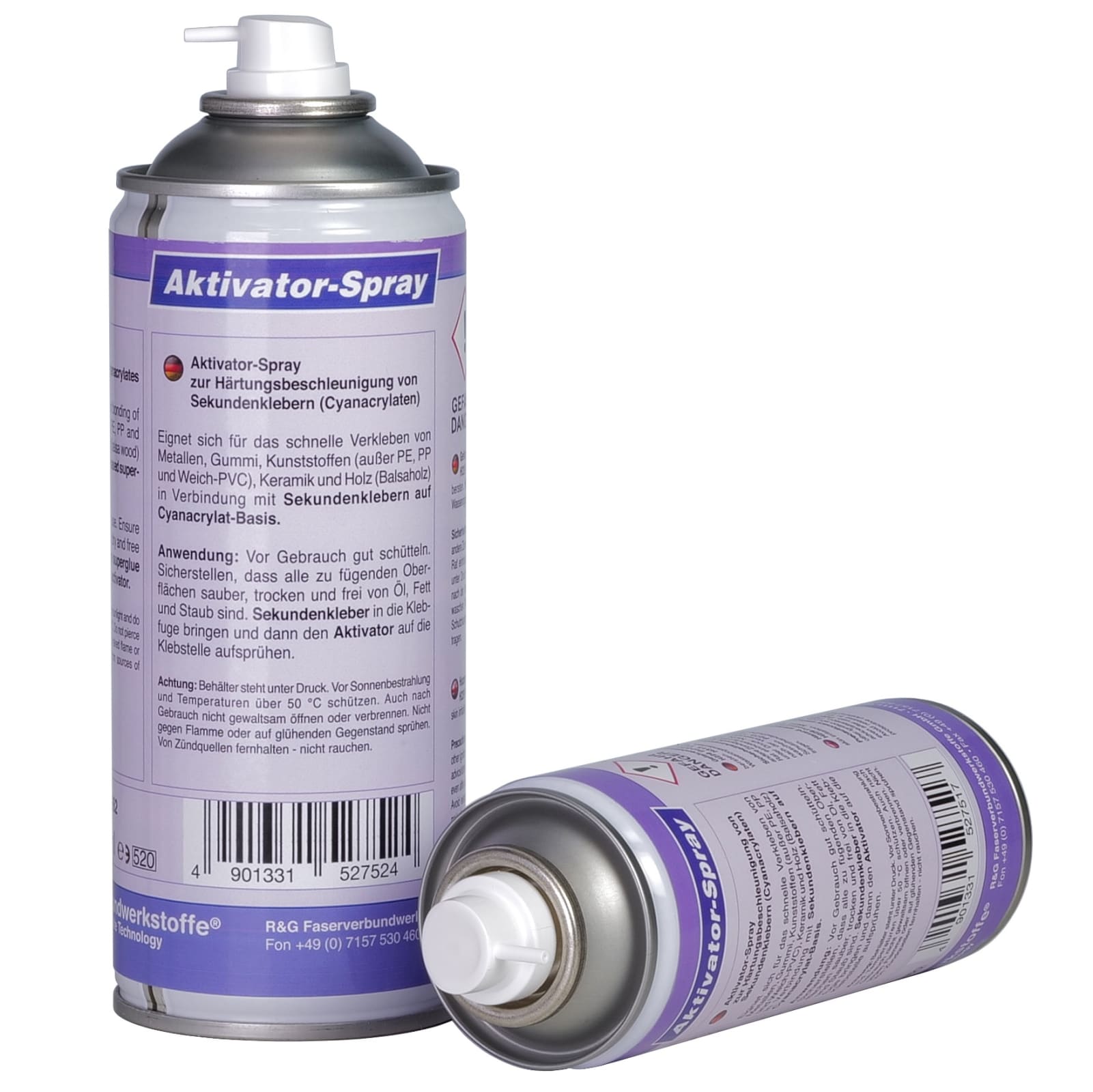
The activator spray for superglues is a powerful curing accelerator for cyanoacrylate adhesives
and ensures immediate, reliable bonding even under difficult conditions. It significantly reduces
curing time and enables fast, clean adhesive bonds – ideal for production, crafts, model making and repair work.
The superglue activator, also known as CA activator, is ideal for fast bonding of metals, rubber,
plastics (except PE, PP and flexible PVC), ceramics and wood, especially balsa wood. By applying
the spray in a targeted manner, the polymerisation of the cyanoacrylate adhesive is accelerated,
ensuring immediate fixation and high initial strength.
Thanks to its fine spray pattern, the cyanoacrylate activator can be applied precisely and economically.
It is particularly useful for parts with imperfect fit, absorbent surfaces, small gaps or low temperatures,
where superglues would normally cure more slowly.
The practical benefit lies mainly in the time saved: parts no longer have to be held in place for a long time,
the bond becomes hand-tight quickly and can be processed further without delay. Especially in series work,
assembly processes, model making or repairs, this considerably improves process reliability.
Advantages
- Accelerates the curing of cyanoacrylate-based superglues
- Enables immediate fixation and high initial strength
- Significantly reduces waiting times during bonding
- Prevents the need to hold parts in place for long periods
- Particularly suitable for balsa wood and absorbent materials
- Fine spray pattern for precise and clean application
- Saves time during assembly, repairs and series production
- Ideal as an activator for superglues / CA adhesives
Typical Applications
- Industry and crafts
- Model making, model aircraft construction and RC applications
- Mould making and jig construction
- CFRP/GFRP small parts and repairs
- 3D-printed parts
- Repair and maintenance work
- Assembly work with superglues
- Bonding of balsa wood, wood, ceramics, rubber, metal and many plastics
Processing
Prepare the surfaces
The surfaces to be bonded must be clean, dry and free from dust, grease and release agents.
Smooth surfaces should be lightly roughened if necessary.
Apply the superglue
Apply the superglue (cyanoacrylate) thinly and evenly to one of the bonding surfaces.
Join the parts
Immediately join the parts accurately and fix them in the desired position.
Apply the activator spray
Spray the activator from a distance of approx. 15–30 cm directly onto the bond line or joint.
The adhesive cures immediately.
Curing
The bond is immediately hand-tight. Full final strength is reached after a short time, depending
on the material and adhesive used.
Finishing / cleaning
Remove excess adhesive immediately after curing. Close the can properly after use.
Important Note
The activator must not be applied before joining the parts, as cyanoacrylate adhesives cure
instantly on contact with the activator, making subsequent repositioning of the parts impossible.
Note
Not suitable for polyethylene (PE), polypropylene (PP) and flexible PVC.
Matching Products
For best results, we recommend using the activator in combination with R&G superglues in low,
medium or high viscosity – depending on gap size, material and application.
A suitable debonder / superglue remover can be used for corrections or for removing adhesive residues.
FAQ
What does an activator for superglues do?
An activator accelerates the curing of cyanoacrylate adhesives. This makes the bond hand-tight very quickly
and allows further processing without delay.
When should activator spray be used?
Activator spray is used when superglue needs to cure particularly quickly, e.g. on absorbent materials,
small gaps, imperfectly fitting parts, at low temperatures or during series production.
Can superglue be used without an activator?
Yes. Superglue generally cures without an activator. However, the activator significantly reduces
waiting time and improves process reliability in demanding applications.
Which materials is CA activator suitable for?
In combination with superglue, the activator is suitable for many materials such as metal, rubber,
ceramics, wood, balsa wood and numerous plastics. It is not suitable for PE, PP and flexible PVC.
Does the activator increase bond strength?
The activator primarily ensures faster curing and high initial strength. Final strength depends on
the superglue used, the materials and the preparation of the bonding surfaces.
Why should the activator only be applied after joining the parts?
Superglue cures very quickly on contact with the activator. If the activator is applied too early,
subsequent alignment or repositioning of the parts may no longer be possible.












 Safety Data Sheet Activator spray for Cyanoacrylates (PDF)