Female-thread fasteners with a round, perforated base plate for broad load distribution in composite and plastic components.
The MS F1 S composite hex nuts can either be embedded directly into a laminate or moulded part, or subsequently bonded using a suitable structural adhesive. The round base plate distributes the applied loads over a considerably larger area than a nut positioned directly in the component. The “S” version features a central opening in the area of the internal thread.
MS F1 S Composite Hex Nuts
These fasteners consist of a hex nut permanently attached to a round, perforated base plate. They provide a reliable internal-thread attachment point in laminates, moulded parts and other components where a conventional through-bolt connection or loose nut would be structurally unsuitable.
Typical applications include composite construction, vehicle and boat building, model making, mould making and equipment construction, for example for attaching panels, brackets, fittings, supports and installed components.
The fasteners can either be embedded during manufacture of the component or subsequently bonded to a finished surface.
Round Base Plate for Load Transfer
The large base plate distributes tensile and shear loads over a larger area of the laminate or bonded joint. This reduces local stress concentrations compared with a point-type fastening.
The numerous perforations in the base plate allow resin or adhesive to pass through during laminating or bonding. This additionally provides mechanical interlocking of the base plate within the laminate or adhesive structure.
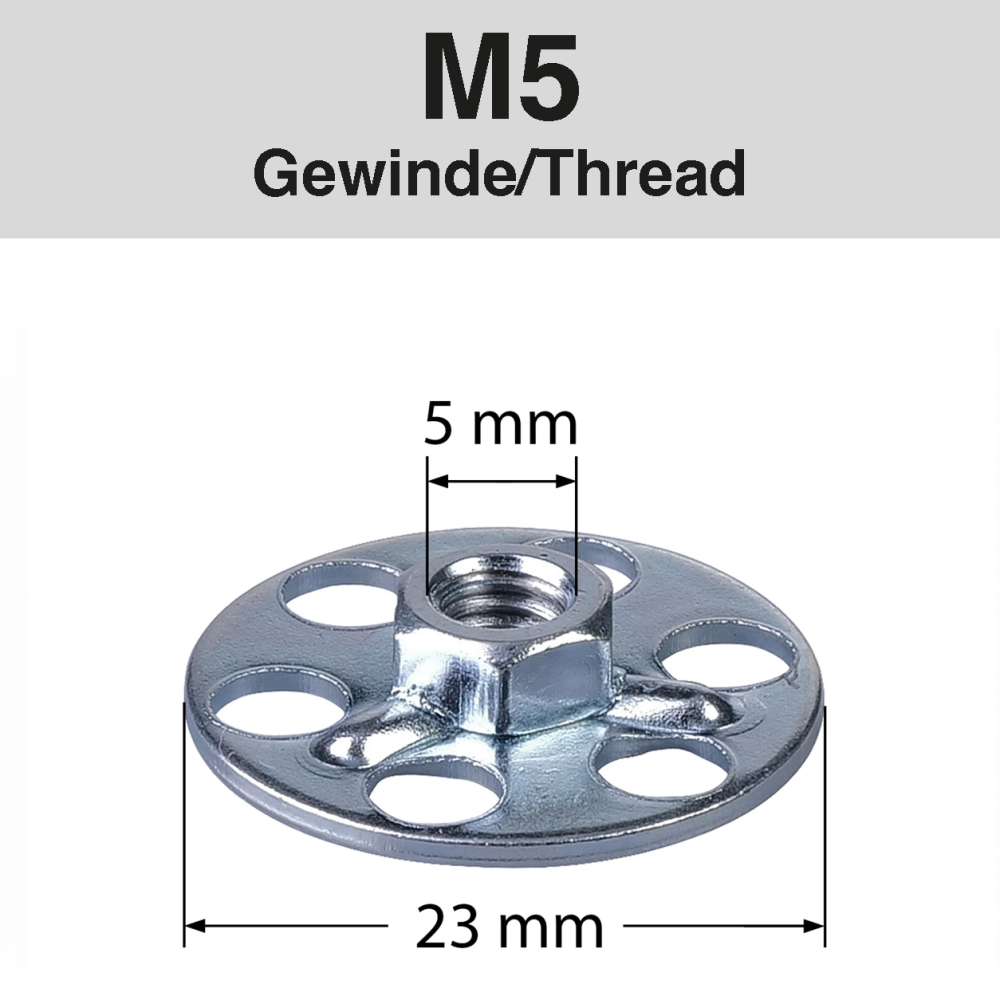
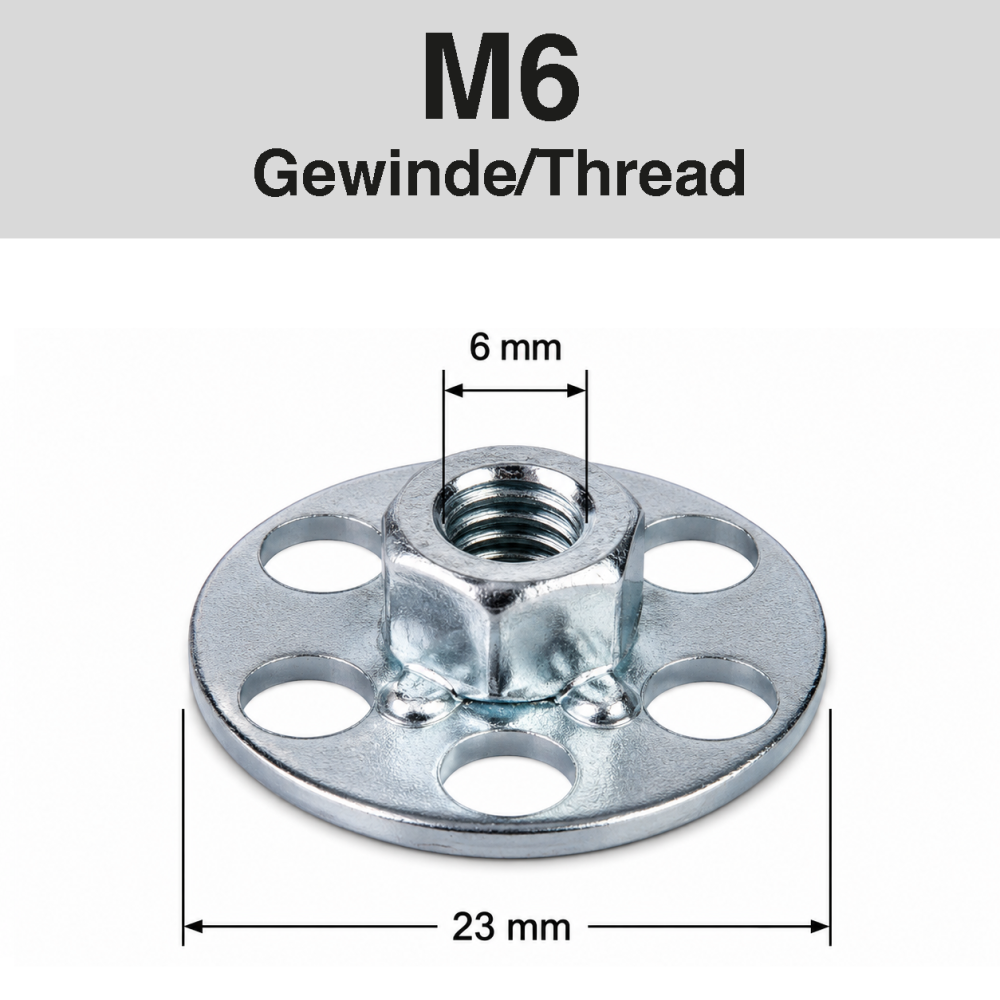
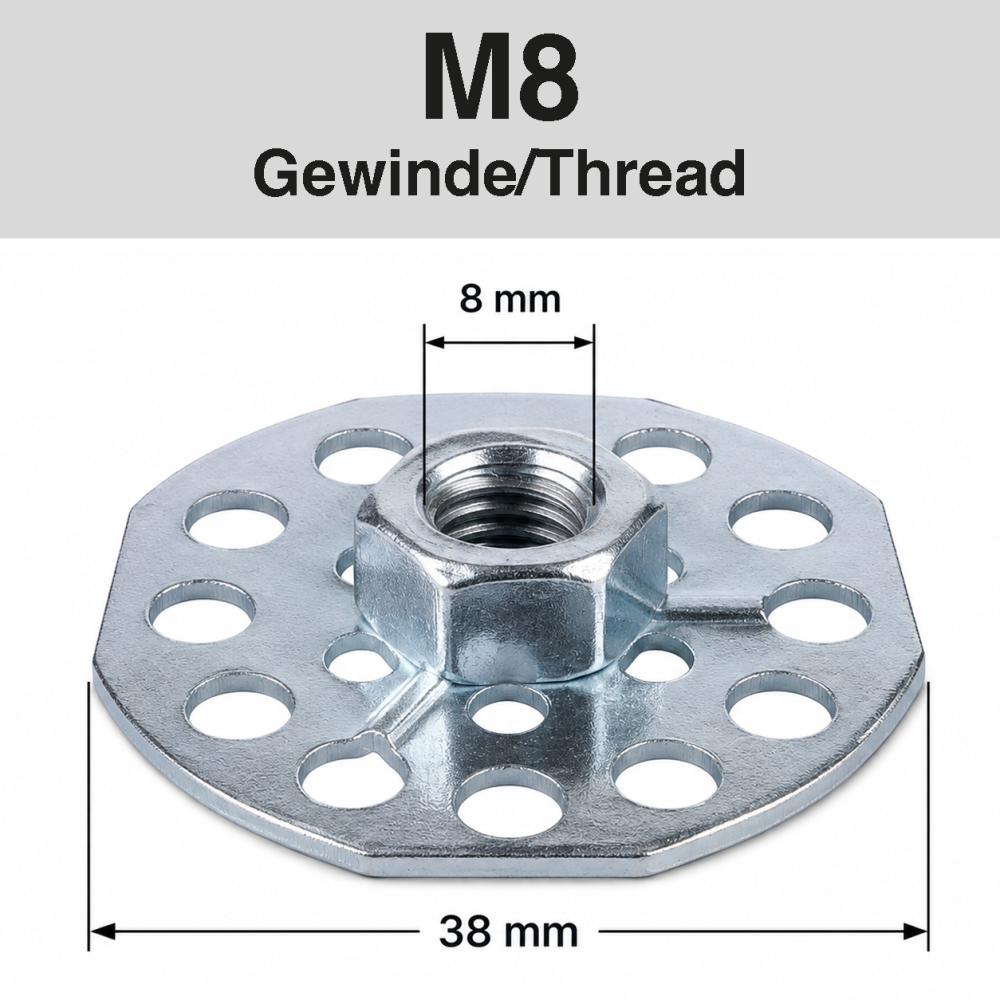
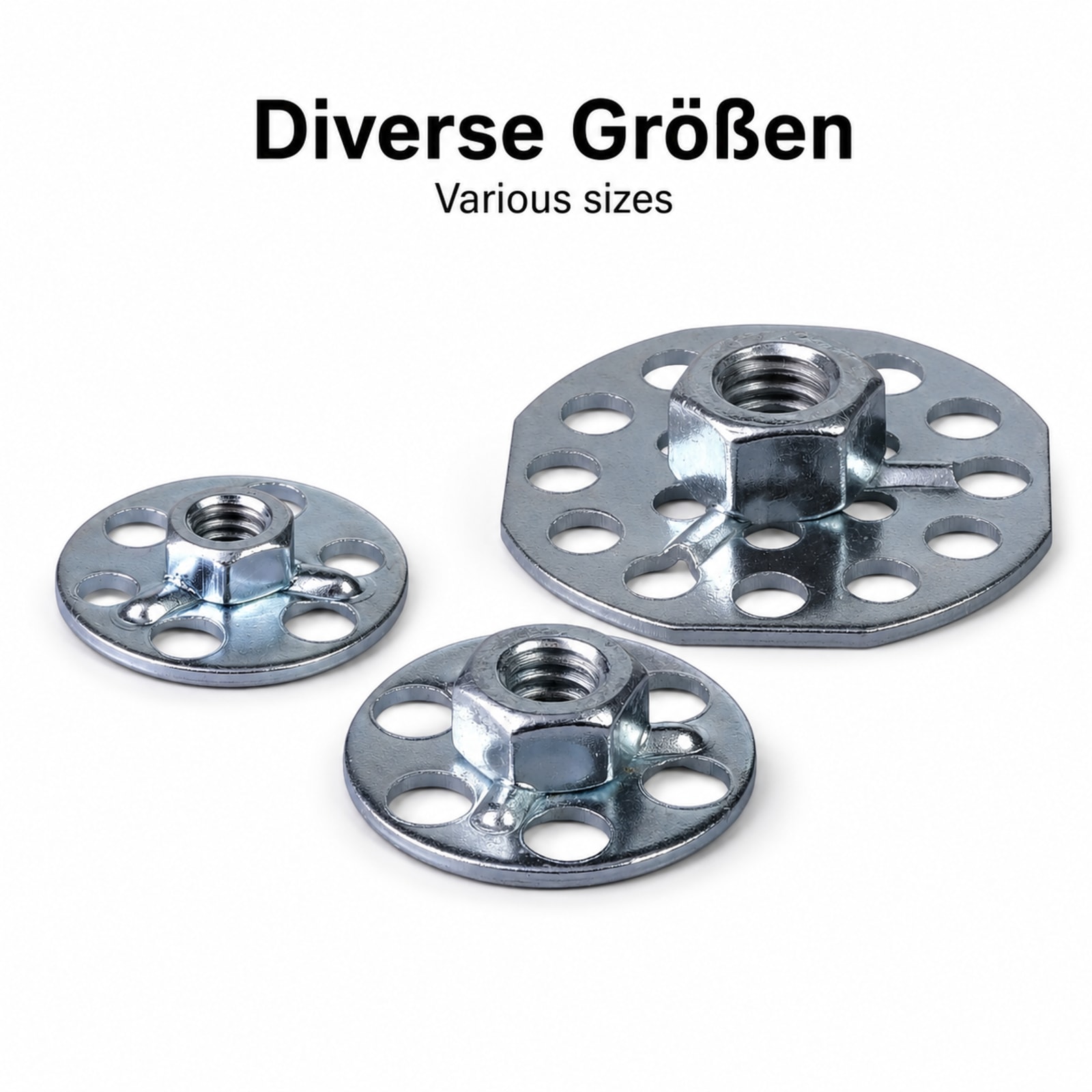
R&G offers versions with 23 and 38 mm round base plate diameters.
Version with Central Opening
The designation S identifies a base plate with a central opening beneath the hex nut.
The internal thread is therefore open at the bottom. Provided that the component is designed accordingly, a screw can pass beyond the nut and through the plane of the base plate.
When designing the joint, sufficient clearance or a corresponding hole or recess must therefore be provided behind the fastener if longer screws are to be used.
Processing
Laminating in / embedding
The fastener can be integrated into the component during laminate lay-up. Resin and reinforcement fibres should engage the base plate as uniformly as possible. The perforated base plate provides effective mechanical interlocking with the laminate structure.
For more highly loaded joints, the base plate should not merely be covered by a thin outer laminate layer, but should be adequately integrated into the laminate structure.
Subsequent bonding
On finished components, the base plate can be bonded using a suitable structural adhesive. The bonding surfaces must be clean, dry and free from grease, dust, release agents and other contaminants that could impair adhesion.
Smooth surfaces should be prepared in accordance with the requirements of the adhesive system being used. For uneven surfaces, a sufficiently thixotropic, gap-filling structural adhesive is recommended.
Suitable Materials
Depending on the manufacturing and fastening method, suitable substrates include:
GRP laminates
CFRP laminates
SMC and BMC components
thermoset and thermoplastic materials
sandwich components
polymer foams
elastomers and rubber
other sufficiently load-bearing moulded parts and materials
Versions Available from R&G
M5 – round base plate Ø 23 mm
M6 – round base plate Ø 23 mm
M8 – round base plate Ø 38 mm
A larger base plate generally provides a larger area for load transfer. However, the actual load-bearing capacity is not determined by the thread size or base plate diameter alone.
Material
Manufactured from mild steel with a corrosion-protective surface treatment.
Version Designation
Example: MS F1 S 23 M6
MS = mild steel
F1 = hex nut with internal thread
S = version with central opening in the base plate
23 / 38 = diameter of the round base plate in mm
M5 / M6 / M8 = internal thread size
Technical Notes
The permissible load is not determined by the thread size alone. Important factors include the laminate structure, base plate size, adhesive or resin system and the quality of load transfer into the component.
For high tensile and shear loads, the base plate should be selected sufficiently large and properly integrated into the component structure.
With sandwich components, care must be taken to ensure that the skins and core material are not locally overloaded by the applied forces.
The central opening of the S version must be taken into account in the component design, particularly when the screw extends beyond the nut.
For CFRP components exposed to moisture, the electrochemical compatibility between the carbon fibres and the metallic fastener should be considered. Electrical or galvanic isolation may be required depending on the application.
For safety-relevant or highly loaded joints, we recommend testing the complete connection on the intended component under realistic service conditions.
R&G
Composite hex nut MS F1 (S Ø23 / M5) , pack/ 12 pcs.
Item no. 2912203
Only 7 left in stock, more on the way
(delivery time 1-2 days)