




Boat Building Materials – Composites for Boatyards and Boat Builders
In boat building, the choice of boat building materials determines the weight, stiffness and service life of a hull. Resin system, reinforcement and core material have to work together. R&G supplies boatyards, boat builders and repair shops with the components for laminate and sandwich construction from a single source. These include epoxy systems approved by Germanischer Lloyd (GL), glass non-crimp fabrics, PVC foam cores and the matching vacuum equipment. Our technicians will advise you on material selection, layup and processing.

Why Use Composites in Boat Building?
GFRP (glass fiber reinforced plastic) has been the standard material in series and one-off boat building for decades. For racing yachts and rowing shells, carbon and aramid fibers are added when every gram counts. Compared with wood and metal, composites offer clear advantages:
- Low weight: Composite laminates and sandwich parts are significantly lighter than solid construction at the same stiffness.
- Water resistance: Cured epoxy resins absorb very little water and are far less prone to osmosis (blistering caused by water ingress) than polyester resins.
- Design freedom: Hulls, decks and add-on parts are produced seamlessly in one piece.
- Easy repair: Damaged areas can be relaminated locally without replacing the component.
Approvals for Boat Building
For boats built to the rules of a classification society, the resins used must meet defined minimum values. These include tensile and flexural strength, elongation at break, heat deflection temperature and water absorption. The detailed requirements are summarized in our wiki article on boat building with composites.
The systems Epoxy Resin L + Hardener GL 1 and Epoxy Resin L + Hardener GL 2 are approved by Germanischer Lloyd for the construction of boats and wind turbine rotor blades. For polyester construction, we offer UP laminating resin SYNOLITE 5690-P-1, which is approved for boat building by Det Norske Veritas and Lloyd's Register.
Which Boat Building Materials Do You Need?
GL-Approved Marine Epoxy Systems
Epoxy Resin L is a low-viscosity laminating resin with 820 mPas at 25 °C. It reliably wets out glass, aramid and carbon fibers and is also suitable for bonding. With Hardener GL 1, the working time is approx. 30 minutes. With Hardener GL 2, it is approx. 210 minutes. Both hardeners use a mixing ratio of 100 : 30 by weight. The two hardeners can be blended to adjust the working time to part size and process. For optimum mechanical properties, we recommend a post-cure at a minimum of 40 °C for 15 hours. Resin and hardener are also available separately, for example Epoxy Resin L and Hardener GL 2.
Glass Fabrics, Non-Crimp Fabrics and Mats
For hulls and decks, boat builders usually combine woven glass fabrics with non-crimp fabrics. Biaxial ±45° glass non-crimp fabrics with 340 or 440 g/m² absorb shear and torsional loads and build up wall thickness quickly. In polyester hand layup, glass mats are also used. For epoxy resin, choose mats with powder binder, as emulsion binders are designed for polyester and vinyl ester resins. You will find the complete range under Glass Fiber.
Carbon and Aramid for Lightweight and Racing Boats
Where weight and stiffness are the priority, for example in racing yachts, rowing shells or masts, carbon fiber fabrics are the first choice. Aramid fabrics increase impact resistance in the bow and keel area. Spread tow fabrics from TeXtreme allow even thinner and lighter laminates, as a case study from the America's Cup shows.
Core Materials for Sandwich Construction
In sandwich construction, a lightweight core separates two laminate skins. This increases the bending stiffness of hulls, decks and bulkheads with little added weight. A proven core in boat building is Divinycell PVC foam in grades H60 and H80. The sheets are available in thicknesses from 1 to 30 mm. For curved surfaces, contoured versions with grid scoring and grooves adapt to the shape of the hull. Tips on joining core sheets can be found in our article on joining sandwich materials.
Gelcoats and Surface Coatings
The gelcoat protects the laminate against water, UV radiation and abrasion and defines the surface quality. For epoxy construction, EP gelcoat NOVA is suitable. For polyester construction, use UP pre-gel white. You will find all systems under Gelcoats. What matters during processing is explained in our wiki article on gelcoats.
Vacuum Infusion and Vacuum Equipment
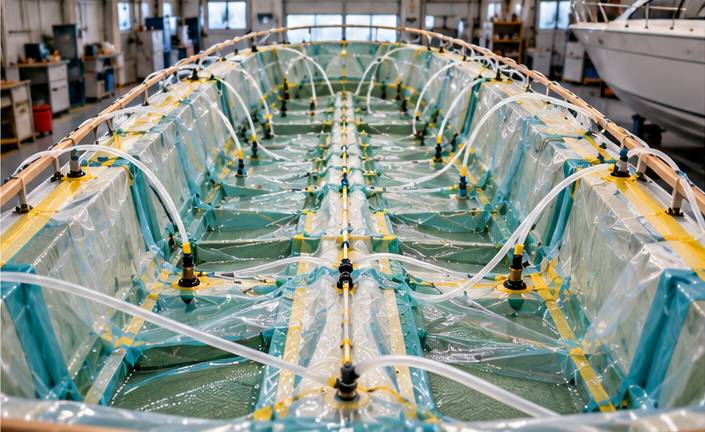
Many boatyards produce hulls and decks by vacuum infusion. The dry reinforcements are placed in the mold, and the resin is drawn through the layup by vacuum. The result is a reproducible fiber volume content, lower resin consumption and fewer emissions in the workshop. Epoxy Resin L with the GL hardeners is suitable for infusion, and Hardener GL 2 with its longer working time is recommended for large parts. You will find further resins under Vacuum Infusion/RTM and films, flow media, peel ply and pumps under Vacuum Technology. The setup is described step by step in our wiki article on vacuum infusion.
Adhesives, Fillers and Mold Making
For bonding bulkheads, stringers and fittings as well as for filling and fairing, adhesives and fillers and filler powders complement the resin system. For building your own hull molds, you will find mold resins, release agents and accessories in our range.
Applications in Boat Building
- Hulls and decks: Hand layup, vacuum bagging and infusion for one-offs, small series and prototypes.
- Racing yachts and rowing shells: R&G works with the Empacher boatyard, one of the world's leading manufacturers of racing rowing boats. Teams and workshops will find the matching repair materials in the Empacher range.
- Canoe and kayak building: Lightweight fiberglass and carbon boats in hand layup, as in the wiki example on building a canoe.
- Refit and repair: Relaminating damaged areas, osmosis protection with epoxy resin and fiberglass sheathing of wooden kayaks and canoes.
- Interior and add-on parts: Bulkheads, floors, hatches and covers in sandwich construction.
What Matters During Processing
- Mixing ratio: Weigh resin and hardener precisely by weight. Deviations reduce strength and durability.
- Temperature: Epoxy Resin L cures from 15 °C with Hardener GL 2 and from 10 °C with Hardener GL 1. Workshop, materials and mold should be at the same temperature.
- Post-cure: Post-curing at a minimum of 40 °C for 15 hours improves the mechanical properties.
- Material requirements: Plan layup and resin quantity in advance with the laminate calculator and the resin calculator.
- Occupational safety: Wear gloves, safety goggles and, when sanding, respiratory protection. You will find suitable equipment under Safety Equipment.

For questions about layup, approvals or process selection, our technical consultancy will be happy to help.
FAQ – Frequently Asked Questions About Boat Building Materials
Which epoxy resin is suitable for boat building?
For professional boat building, we recommend Epoxy Resin L with Hardener GL 1 or GL 2. Both systems are approved by Germanischer Lloyd for the construction of boats. Hardener GL 1 offers approx. 30 minutes of working time, Hardener GL 2 approx. 210 minutes for large parts and infusion.
Is epoxy or polyester resin better for boat building?
The choice depends on the component and the process. Epoxy resin bonds better, is tougher and is far less prone to osmosis. It is therefore the first choice for highly loaded laminates, sandwich parts and repairs. Polyester resin is less expensive and common in classic series production with glass mats.
What does GL approval mean for a resin system?
Germanischer Lloyd (now part of DNV) is a classification society for ships and boats. A GL-approved resin system meets tested minimum values, for example for strength, elongation at break and water absorption. Boatyards can therefore use it for classed components, provided the layup and production also meet the requirements.
Which core material is suitable for sandwich hulls?
PVC foam such as Divinycell H60 or H80 has proven itself in boat building. It is lightweight and stiff and easy to cut and bond. For curved hull areas, contoured sheets with grid scoring adapt to the shape.
Are epoxy laminates resistant to osmosis?
Yes, largely. Properly cured epoxy resins absorb very little water and are therefore far less prone to osmosis than polyester laminates. Osmosis mainly occurs in polyester laminates. Background information can be found in our wiki article on osmosis.
Can the GL-approved systems be used for vacuum infusion?
Yes. With 820 mPas at 25 °C, Epoxy Resin L has a low viscosity and is suitable for vacuum infusion, RTM and vacuum bagging. For large hulls, Hardener GL 2 with approx. 210 minutes of working time is recommended.

