



Empacher

Glass fibre for epoxy resin – Versatile products from R&G
Glass fibre - also widely known as fibreglass or fiberglass - is one of the most established and versatile reinforcement materials in composite construction. Whether you are building a boat hull, a wind turbine blade, an automotive body panel, or a lightweight sporting goods component, glass fibre offers a compelling combination of strength, affordability, and ease of processing. At R&G, we supply a comprehensive range of glass fibre fabrics, rovings, and multiaxial reinforcements for professional composite applications.
What is Fibreglass?
Fibreglass is a fibre-reinforced plastic (FRP) in which glass fibres serve as the reinforcing component, typically embedded in a polymer matrix such as epoxy, polyester, or vinyl ester resin. The term is used both to describe the raw reinforcement material - the glass fibre itself - and the finished composite material made from it.
The glass fibres used in composite construction are drawn from molten glass into continuous filaments of exceptionally fine diameter, typically between 3 and 24 micrometres. These filaments are bundled into rovings or woven into fabrics, which are then impregnated with resin and cured to form a rigid, lightweight composite structure.
Fibreglass combines relatively high tensile strength with low weight, electrical insulation properties and good resistance to moisture and many chemicals. It is also considerably less expensive than carbon fibre, making it the material of choice for large-volume applications where cost efficiency matters.
Production of Glass Fibres
The production of glass fibres begins with the melting of raw materials - primarily silica sand, limestone, kaolin clay, and various oxides - at temperatures of around 1,400–1,600 °C. The molten glass is then extruded through a bushing plate containing hundreds of fine holes, drawing the glass into continuous filaments as it cools.
The filaments are immediately coated with a chemical sizing - a surface treatment that serves several purposes: it protects the fibres from abrasion during handling, improves the adhesion between the glass fibre and the resin matrix, and can be tailored to optimise compatibility with specific resin systems (e.g. epoxy or polyester).
The coated filaments are then gathered into strands and wound onto bobbins as rovings, or woven, knitted, or stitched into the various fabric architectures used in composite processing.
The Different Types of Fibreglass
Not all glass fibres are the same. Several compositional variants have been developed, each optimised for specific performance requirements:
- E-Glass (Electrical Glass): By far the most widely used type, E-glass offers a well-balanced combination of tensile strength, stiffness, electrical insulation, and moisture resistance at a competitive price point. It is the standard choice for the vast majority of composite applications, from boat building to construction reinforcement.
- S-Glass (Structural Glass): S-glass contains a higher proportion of silica and magnesium oxide, giving it significantly higher tensile strength and stiffness than E-glass - roughly 40% stronger. It is used in demanding structural applications such as aerospace components, ballistic armour, and high-performance sporting goods, where its higher cost is justified by the performance gains.
- ECR-Glass (Corrosion-Resistant Glass): A variant of E-glass with improved resistance to acids and alkalis, ECR-glass is used in applications where chemical attack is a concern - such as pipes, tanks, and chemical processing equipment.
- D-Glass (Dielectric Glass): Optimised for low dielectric constant and loss, D-glass is used in applications requiring minimal electromagnetic interference, such as radomes and printed circuit boards.
- AR-Glass (Alkali-Resistant Glass): Developed specifically for use in cement and concrete reinforcement, AR-glass contains zirconium oxide to resist the highly alkaline environment of cementitious matrices.
For most composite laminating work - and for the products available at R&G - E-glass and S-glass are the most relevant types.
The Characteristics of Fibreglass
Understanding the key properties of glass fibre helps in selecting the right material and designing effective laminates:
- Tensile strength: E-glass fibres have a tensile strength of approximately 3,400–3,500 MPa; S-glass reaches up to around 4,600 MPa. These values relate to the pure fibre - in a composite laminate, effective strength depends on fibre volume fraction, fibre orientation, and resin quality.
- Density: At approximately 2.54 g/cm? (E-glass), glass fibre is heavier than carbon fibre (approx. 1.78 g/cm?) or aramid (approx. 1.44 g/cm?), but still far lighter than metals such as aluminium or steel.
- Stiffness (modulus): E-glass has a tensile modulus of approximately 70–73 GPa - comparable to aluminium, but lower than carbon fibre (230–700 GPa depending on grade). For stiffness-critical applications, carbon fibre or hybrid laminates may be preferable.
- Electrical insulation: Glass fibre is an excellent electrical insulator, which makes it valuable in electrical and electronic applications.
- Chemical and moisture resistance: Glass fibre composites show good resistance to many chemicals, oils, and solvents. Moisture absorption is low, though prolonged exposure to water can gradually reduce mechanical performance - particularly in polyester-based laminates.
- Thermal properties: Glass fibre retains its structural integrity up to relatively high temperatures compared to polymer matrices; the practical temperature limit of the composite is typically governed by the resin system used.
- Optical transparency: Glass fibres are inherently transparent to light, a property exploited in optical fibres and certain decorative applications.
Technical data of E-Glass:
| Density (at 20 °C) |
2,6 g/cm³ |
| Tensile strength |
3400 MPa |
| Tensile modulus | 73 GPa |
| Elongation at break |
3,5 - 4 % |
| Cross-contraction number |
0,18 |
| Electrical resistivity (at 20 °C) | 1015 (Ω/cm) |
| Therm. Coefficient of expansion | 5 (10-6 K-1) |
| Dielectric constant | 5,8 - 6,7 (106 Hz) |
Chemical properties
Glass is resistant to oils, greases and solvents and shows good resistance to acids and alkalis up to pH values of 3 - 9. Acids dissolve certain atoms from the glass surface, which leads to embrittlement. Alkalis slowly wear away the glass surface.
- Acetic acid up to 15
- Nitric acid < 30 %
- Hydrochloric acid 15 - 30 %
- Sulfuric acid < 30 %
- ammonia 15 - 30 %
- Caustic soda < 30 %
- hydrogen chloride (after 30 minutes) 25 %
Residual tensile strength of fabrics made of E-glass after 24 hours of storage:
| Temperature (°C) |
Residual tensile strength (%) |
| > 200 | 100 |
| 200 | 98 |
| 300 | 82 |
| 400 | 65 |
| 500 | 46 |
| 600 | 14 |
| 700 | - |
Selection guide glass fibre fabric
| Weight | Width | Weave | Finish |
|---|---|---|---|
| 25 g/m2 | 110 cm | Plain | Interglas FE 600/800 |
| 25 g/m2 | 127 cm | Plain | Interglas FE 600/800 |
| 49 g/m2 | 110 cm | Plain | Interglas FE 600/800 |
| 49 g/m2 | 127 cm | Plain | Interglas FE 600/800 |
| 55 g/m2 | 97,5 cm | Plain | Interglas FE 600/800 |
| 80 g/m2 AERO | 100 cm | Plain | Interglas FK 144 |
| 80 g/m2 | 100 cm | Twill | Interglas FK 144 |
| 105 g/m2 | 100 cm | Twill | Interglas FK 144 |
| 160 g/m2 | 100 cm | Twill | Silane |
| 163 g/m2 AERO | 100 cm | Twill | Interglas FK 144 |
| 163 g/m2 AERO | 130 cm | Plain | Interglas FK 144 |
| 200 g/m2 AERO | 100 cm | Twill | Interglas FK 144 |
| 220 g/m2 AERO | 100 cm | Plain | Interglas FK 144 |
| 280 g/m2 AERO | 100 cm | Twill | Interglas FK 144 |
| 280 g/m2 | 100 cm | Plain | Interglas FK 144 |
| 296 g/m2 AERO | 100 cm | Satin 8H | Interglas FK 144 |
| 390 g/m2 AERO | 100 cm | Twill | Interglas FK 144 |
| 425 g/m2 AERO | 100 cm | Plain | Interglas FK 144 |
| 580 g/m2 | 100 cm | Twill | Silane |
| 600 g/m2 | 100 cm | Plain | Interglas FK 144 |
Buy fiberglass products
Rovings - more than just reinforcement for profile drawing
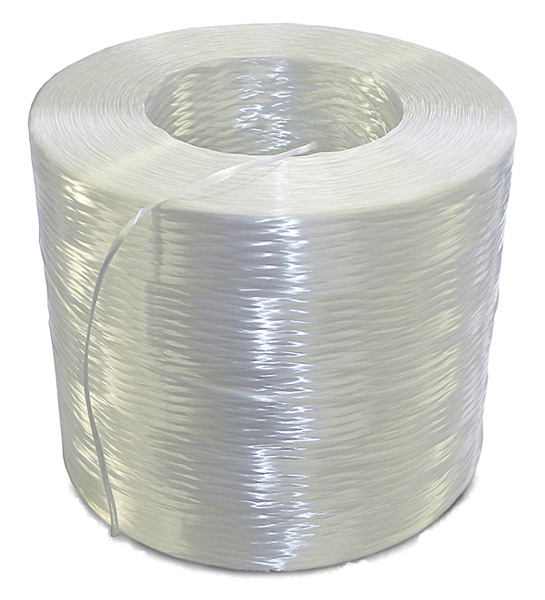
Textile glass rovings consist of one or a certain number of almost parallel glass spinning threads, which are combined into one strand without twisting. Rovings are further processed into roving fabrics, chopped textile glass (glass fiber chips), mats and short fibers. In various manufacturing processes, e.g. winding and profile drawing (strand drawing), rovings are used directly as reinforcement.
Roving fabrics made from textile glass rovings are of particular importance. They can be used to produce thick moulded parts (e.g. in mold making) from a few layers. The fiber content and strength are much higher than for mat laminates but lower than for glass filament fabrics.
Fiber spray rovings immediately disintegrate into individual filaments after cutting. Rovings for winding and hand lay-up (Glass rovings) are much finer and have better cohesion.
Textile glass mats
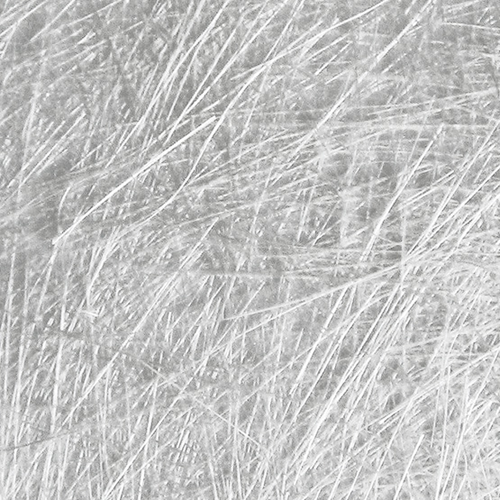
Textile glass mats for hand lay-up are made by randomly layering cut glass spun threads (cut mat). They are bonded by a binder that dissolves in the styrene of the polyester or vinyl ester resin so that the fibers float freely in the resin. In other resins (epoxy), the mat remains completely rigid.
Cut textile glass
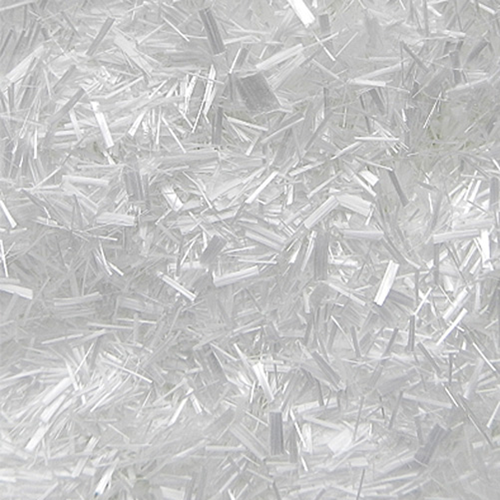
Glass rovings are cut into various lengths for processing in filling and molding compounds. R&G stocks the length 3 mm.
Textile glass short fibers are glass spun threads shredded to lengths of less than 1 mm and split into individual fibers. R&G stocks a ground glass fiber with a length of 0.2 mm.
Toxicity and storage
Glass fabrics do not contain any substances that are hazardous to health or toxic. Due to the filament diameters (greater than 4 µm) and the chemical structure of the glass, no carcinogenic effects occur according to current knowledge. The maximum permissible workplace concentration of glass dust is 6 mg/m? (fine dust). No hazards occur during the transport and storage of glass fabrics. According to the Ordinance on Hazardous Substances, glass fabrics do not have to be labeled. There is no risk to persons or the environment during storage and shipping. Even at high temperatures, glass does not decompose into toxic components and is therefore harmless even in the event of a fire.
When storing glass fiber reinforcements, it must be borne in mind that the coating is sensitive to moisture. Dry, not too cool rooms are best for storage.
If the reinforcing material is stored in rooms that are too cold, the water vapor contained in the warm air will precipitate when it is brought into warm workrooms. In this case, as a precaution, the fiberglass material should be stored in the workshop for at least 8 hours before processing.
Fibreglass combines relatively high tensile strength with low weight, electrical insulation properties and good resistance to moisture and many chemicals. It is also considerably less expensive than carbon fibre, making it the material of choice for large-volume applications where cost efficiency matters.
Which Industries Rely on Fibreglass?
The versatility and cost-effectiveness of fibreglass have made it a foundational material across a broad range of industries:
- Marine and boat building: Fibreglass has dominated boat hull construction for decades, offering excellent resistance to water, ease of moulding into complex shapes, and long service life.
- Wind energy: The blades of wind turbines are almost exclusively manufactured from glass fibre composites, where the combination of stiffness, fatigue resistance, and cost efficiency is essential at the scale required.
- Automotive and transportation: Glass fibre composites are used extensively in body panels, bumpers, underbody components, and structural reinforcements — particularly in commercial vehicles, buses, and rail applications.
- Aerospace: Whilst carbon fibre dominates primary aerospace structures, glass fibre is used in secondary structures, radomes, fairings, and interior components where its lower cost and adequate strength are sufficient.
- Construction and civil engineering: Glass fibre reinforced polymers (GFRP) are increasingly used as rebar substitutes in concrete structures, offering corrosion immunity that steel cannot provide in aggressive environments.
- Sporting goods and leisure: Surfboards, kayaks, helmets, bicycle components, and a wide range of other sporting equipment rely on glass fibre for its toughness, formability, and value.
- Electronics: Printed circuit boards (PCBs) are almost universally built on FR4 - a woven E-glass/epoxy laminate - making fibreglass a literally ubiquitous presence in modern electronics.
FAQ – Glass Fibre and Fibreglass
Is fibreglass harmful to humans?
Glass fibres can cause irritation to the skin, eyes, and respiratory tract upon contact or inhalation, particularly during cutting, sanding, or machining. Short-term skin contact typically causes itching and mild irritation. Inhalation of fine glass dust over prolonged periods without adequate respiratory protection may pose a risk to lung health. With proper personal protective equipment - gloves, safety glasses, and an appropriate dust mask or respirator - the risks associated with working with glass fibre can be effectively managed. Always observe the safety data sheets for the specific products you are using.
Why was fibreglass banned?
Fibreglass as a composite reinforcement material has not been broadly banned. The question likely stems from concerns raised in the past about certain refractory ceramic fibres (RCF) - a different class of high-temperature fibre - which are classified as potentially carcinogenic and are subject to strict occupational exposure limits in many countries. Standard glass fibres used in composite construction (E-glass, S-glass) are not classified in the same category, though sensible precautions during processing are always advisable.
What are other names for fibreglass?
Fibreglass goes by several names depending on context and region: glass fibre, glass-reinforced plastic (GRP), glass-reinforced polymer, fibreglass reinforced plastic (FRP), and - in American English - simply fiberglass. In structural engineering contexts, the abbreviation GFRP (glass fibre reinforced polymer) is commonly used.
Can I touch fibreglass with my bare hands?
It is not recommended. Glass fibres - particularly freshly cut edges and loose fibres from rovings or fabrics - can embed in the skin and cause itching, irritation, and discomfort. Thin nitrile or latex gloves provide adequate protection for most handling tasks. If skin contact does occur, wash the affected area gently with cold water (hot water opens pores and can make removal more difficult) and avoid rubbing, which can push fibres deeper into the skin.
What do I need to keep in mind when working with fibreglass?
Several precautions make working with glass fibre safer and more effective.
- Always wear nitrile gloves to protect your hands from both glass fibres and resin systems.
- Use safety glasses or goggles when cutting or sanding.
- In dusty conditions or when machining cured laminates, wear a particle mask rated at least FFP2 or a half-face respirator with suitable filter cartridges.
- Work in a well-ventilated space, particularly when working with resin systems.
- Wash work clothes separately from regular laundry after working with glass fibre.
- Store fabrics in a dry, clean environment to prevent moisture uptake and contamination of the sizing, which can impair resin adhesion.