



Epoxy Resin for Jewellery – Create Unique Pieces Yourself
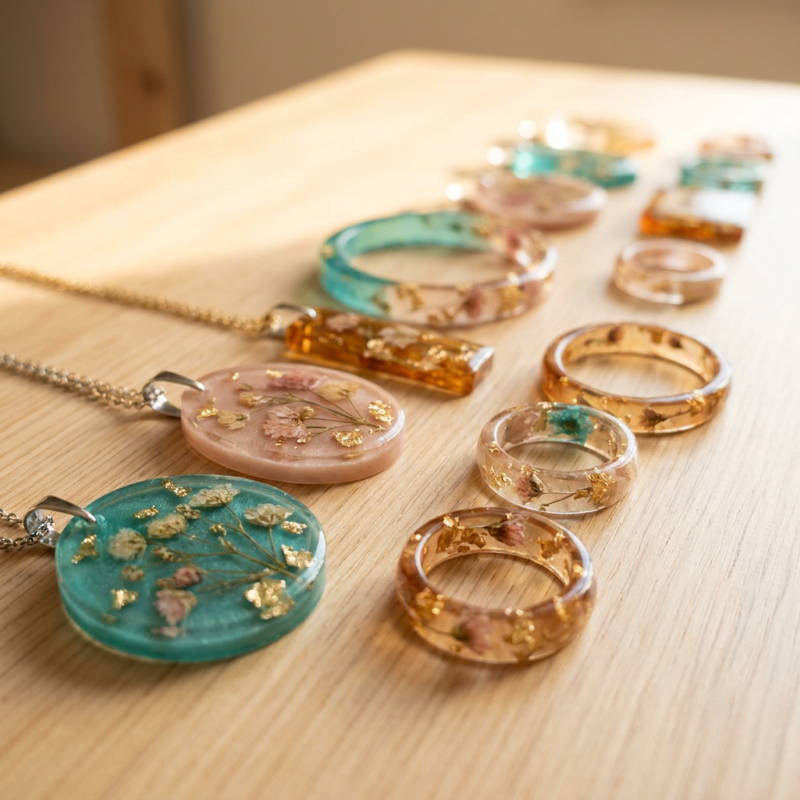
Epoxy resin for jewellery combines craftsmanship with virtually unlimited creative freedom. Whether delicate earrings with embedded dried flowers, shimmering pendants with vibrant colorants, or crystal-clear cabochons with enclosed photo prints – with the right resin for jewelry, you can create unique pieces that rival professionally manufactured products in quality. This page shows you which materials you need, how to work through the process from start to finish, and what really matters during processing.
What Is Epoxy Resin Jewellery?
Epoxy resin – also known simply as "resin" – is a two-component plastic that cures through the chemical reaction of resin and hardener. The result is a glass-like finish – hard, clear and durable – making it an ideal material for jewellery making. Unlike UV resin, which cures under UV light, epoxy resin requires no special lamp: the curing process begins immediately after mixing resin and hardener.
Resin jewelry is lightweight, dimensionally stable and can be coloured, filled and finished in countless ways. This is precisely why epoxy resins have become the material of choice for DIY jewellery, resin art and handcrafted accessories in recent years.
What Jewellery Can You Make with Epoxy Resin?
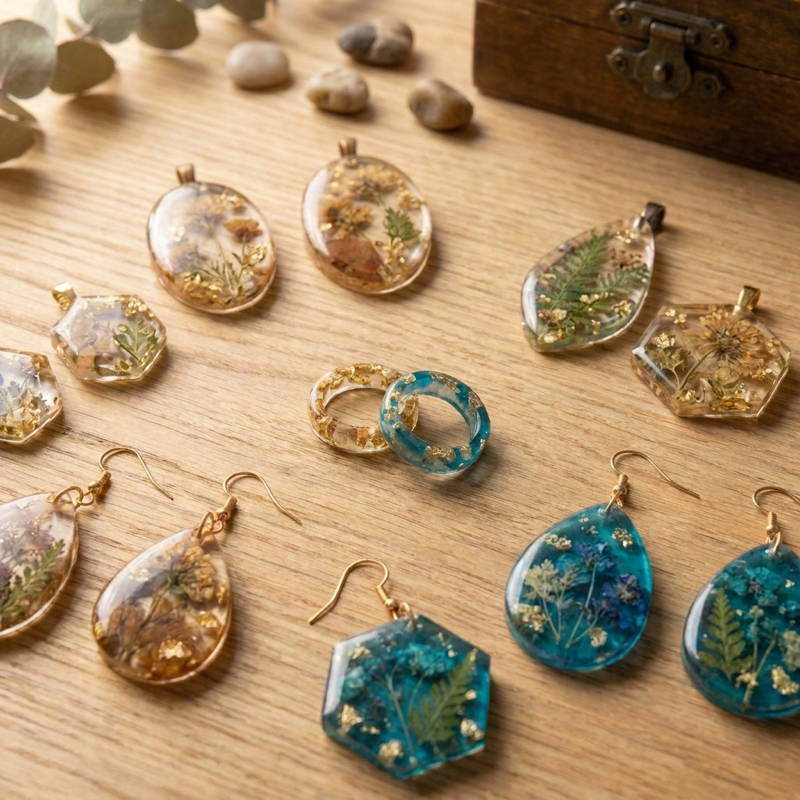
The range of jewelry projects you can realise with epoxy resin is impressively broad. With the right resin molds and materials, virtually all classic jewellery forms are achievable:
Pendants & Cabochons
Round or teardrop-shaped cabochons are among the most popular jewelry projects for beginners. They can be filled with flowers, glitter or foils and then set into findings.
Rings & Bracelets
Flexible silicone molds allow you to cast rings and bracelets with consistent results. Particularly popular: rings with vibrant colorants or embedded natural materials.
Earrings
Thin, lightweight earring shapes can be built up from epoxy resin in thin layers – ideal for delicate designs with colour gradients or inlaid elements.
Brooches & Hair Accessories
Larger surface areas, such as brooches or hair clips, can also be cast without difficulty. Working in multiple thin layers is recommended here to avoid voids and bubbles.
Jewellery with Embedments
Dried flowers, glitter, foils, photo prints or natural materials – all of these can be permanently encased in resin to create truly one-of-a-kind pieces.
Which Epoxy Resin Is Suitable for Jewellery?
Not every epoxy resin is suited to jewellery making. Three properties are particularly important: crystal-clear curing, low viscosity for bubble-free filling of fine resin molds, and minimal yellowing even after prolonged UV exposure.
Why R&G Epoxy Casting Resin WATER-CLEAR Is the Right Choice
The Epoxy Casting Resin WATER-CLEAR + Hardener W 300 from R&G was developed specifically for casting applications where the highest optical clarity is required. It cures to a water-clear, glass-like finish, offers low viscosity for easy filling of even the smallest resin molds, and is therefore ideally suited for professional quality jewellery making.
The resin is also available individually: Epoxy Casting Resin WATER-CLEAR, combinable with Hardener W 300 – the ideal choice when working in larger quantities.
As a high-quality epoxy resin made in Europe, the R&G system meets all relevant safety and environmental standards (REACH, RoHS) and is produced and warehoused in Germany – ensuring fast delivery and reliable availability. Should you have any questions about processing, the R&G technical team is available to assist you personally by phone.
What You Need for Epoxy Resin Jewellery – Materials & Equipment
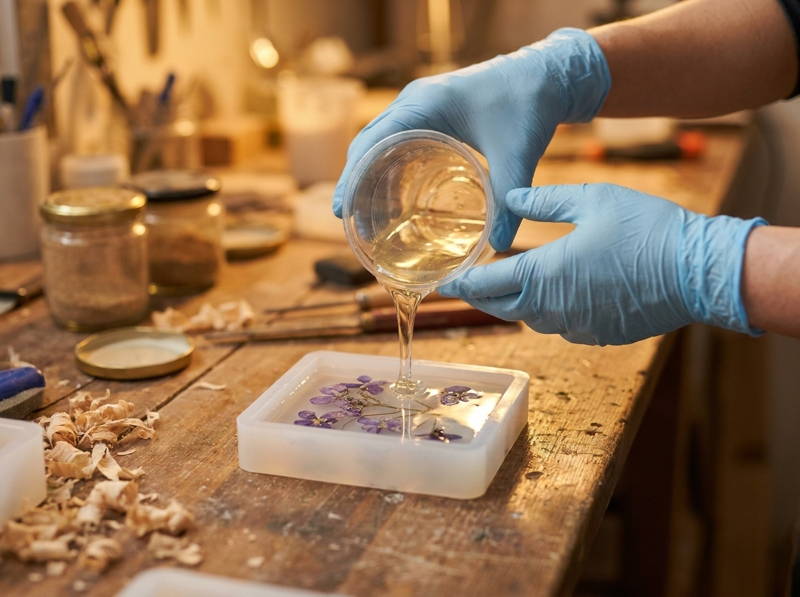
Whether you are just starting out or looking to expand your setup, the right epoxy resin for jewelry making kit makes all the difference. Here is what you need:
- Epoxy resin + hardener (e.g. R&G Epoxy Casting Resin WATER-CLEAR + Hardener W 300)
- Silicone molds for jewellery (reusable, release without residue)
- Release Spray TRS – protects silicone molds from epoxy resin and extends their service life
- Precision digital scale
- Mixing cups and stir sticks
- Stir sticks
- Protective gloves
- Epoxy colors & pigments
- Glitter powder or dried flowers
- Fine sandpaper (from grit 400) & polishing compound
How to Make Epoxy Resin Jewellery – Step by Step
Step 1 – Preparation & Safety
Work in a well ventilated area and always wear protective gloves. Cover your work surface with foil or baking paper. Prepare all materials before mixing resin and hardener – once mixing begins, the working time starts. Tip: Apply Release Spray TRS to your silicone molds before pouring – it makes the surface wettable, acts as a protective barrier and extends the service life of your molds, particularly when working with epoxy resins.
Step 2 – Accurately Weighing and Mixing Resin and Hardener
Weigh resin and hardener precisely according to the specified mixing ratio. For the R&G Epoxy Casting Resin WATER-CLEAR with Hardener W 300, a fixed weight ratio applies – please refer to the product information on the packaging or in the shop. Mix both components slowly and thoroughly for at least 3–5 minutes, regularly scraping the sides and bottom of the mixing cups. Important: stir slowly when mixing resin to minimise the introduction of air bubbles.
Step 3 – Adding Colours & Embedments
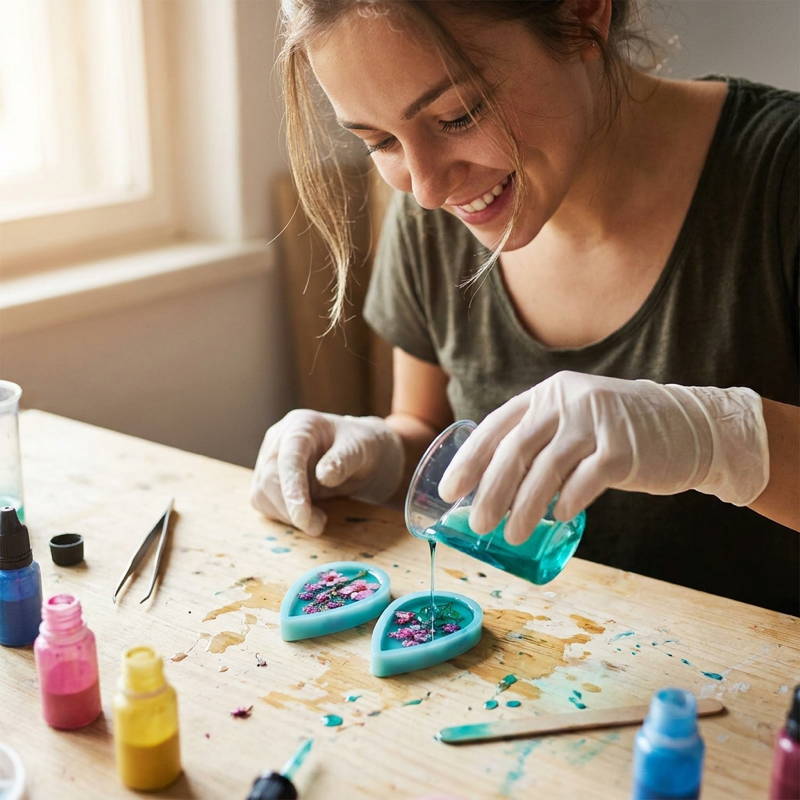
Now add pigments, vibrant colorants or glitter to the mixture and stir again carefully. Embedments such as dried flowers should be placed directly in the mold, not mixed into the resin beforehand.
Step 4 – Pouring into the Mold
Pour the resin slowly and in a controlled manner into the silicone molds. For complex shapes, work in thin layers to ensure complete curing without excessive heat build-up. Bubbles can be removed by briefly passing a heat gun on its lowest setting or a small torch over the surface at a safe distance.
Step 5 – Cure Time
Cover the mold to protect it from dust and allow the resin to cure at room temperature. Hardener W 300 has a pot life of approx. 300 minutes – full cure time is reached after 24–48 hours, depending on layer thickness and room temperature. Do not demould too early.
Step 6 – Sanding, Polishing & Finishing
After complete curing, the finished jewellery pieces can be demoulded, sanded with fine sandpaper if needed, and then polished to a high-gloss, glass-like finish. Eyelets, hooks or settings can then be attached.
Tip: Make Your Own Silicone Molds
Anyone who needs individual shapes for unique jewellery does not have to rely on standard molds. In our blog post on making your own silicone molds, you will learn how to create your own castings and design your jewellery exactly as you envision it.
FAQ – Frequently Asked Questions About Epoxy Resin for Jewellery
Which epoxy resin is best for jewellery?
For jewellery, casting resins with low viscosity and water-clear curing are particularly well suited. The R&G Epoxy Casting Resin WATER- CLEAR was developed precisely for such applications: it cures crystal-clear, accepts vibrant colorants easily and shows minimal yellowing over time. You can find further information directly in the R&G shop.
Is epoxy resin suitable for jewellery?
Yes – epoxy resin is one of the most widely used materials for handmade jewellery. It is lightweight, dimensionally stable, can be designed in countless ways, and is skin-compatible once fully cured. It is important to wear protective gloves during processing, as uncured resin can cause skin irritation.
What is better – UV resin or epoxy resin?
Both materials have their place. UV resin cures quickly and is well suited for very thin layers and small quantities. Epoxy resin, on the other hand, offers a longer working time, can be processed in larger quantities and achieves more even curing in deeper pours. For jewellery with embedments or deeper molds, epoxy resin is generally the better choice.
How do I care for epoxy resin jewellery?
Epoxy resin jewellery is easy to care for: clean it with a soft, slightly damp cloth. Avoid aggressive cleaning agents, solvents and prolonged direct sunlight, as UV light can gradually dull the surface. Store your jewellery in a jewellery box for best results.
How long does resin jewellery last?
With correct processing and care, epoxy resin jewellery is extremely durable. Mechanical stability is maintained for years. Direct UV exposure can cause slight yellowing of the surface over time – however, a high-quality epoxy resin such as the R&G WATER-CLEAR system minimises this effect significantly.