



Fiberglass Surfboard: Build and Repair It With the Right Materials
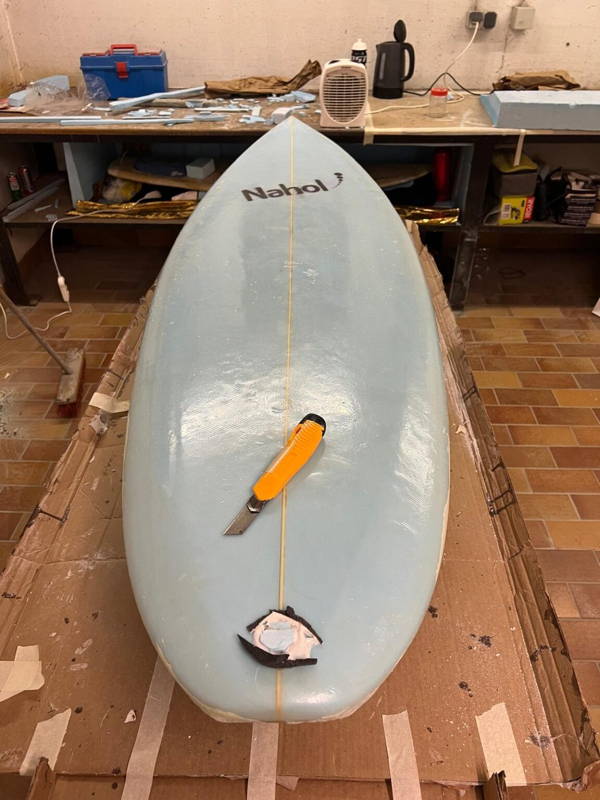
Whether shortboard, fish or longboard: building your own surfboard or fixing a broken one comes down to using the right, matched materials. The real difference is made by the correct epoxy resin and the matching glass fabric. R&G supplies exactly the same combination the pros use, from a single source, including expert advice and detailed step-by-step guides in our wiki.
Why glass fibre and epoxy are the ideal surfboard material
A surfboard typically has a lightweight foam core wrapped in a thin, fibre-reinforced laminate. This construction is standard for good reason:
- Low weight at high strength, because the glass fibre carries the loads while the foam core provides buoyancy.
- High impact and break resistance thanks to the tough epoxy laminate.
- A waterproof, repair-friendly surface that can be re-laminated at any time.
- Full design freedom, since the resin can be tinted and the board can be painted.
For clear decks with minimal yellowing we recommend a highly transparent epoxy resin. It is more UV-stable and visually far superior to standard polyester resin.
Which materials do I need to build a surfboard?
Epoxy resin
The heart of every board is the laminating resin. A proven choice is the highly transparent Epoxy Resin HT 2: crystal-clear, low-yellowing and easy to process. The mixing ratio (HT 2: 100:48) must be followed precisely using a gram scale. Depending on size, expect roughly 1 to 2 kg of resin including hardener per board. You will find all systems in the Epoxy resins category.
Glass fabric

For the reinforcement, use twill-weave glass fibre fabric. For surfboards, a 163 g/m² twill fabric has proven ideal: light, easy to drape and transparent in the finished laminate. Typically one layer goes on the bottom and two on the deck, with extra reinforcement at nose and tail. Browse the full range under Glass fibre.
Core, fillers & fins
Lightweight XPS or rigid foam boards work well as a core. To set fin plugs and to fill, mix epoxy resin with glass micro-balloons and other fillers into a light, spreadable paste.
Tools & safety equipment
For clean lamination you need laminating tools such as brushes, spreaders and bubble rollers. When working with resin, safety comes first: gloves, goggles and a respirator are available in the Safety equipment category.
Build a surfboard step by step
From shaping and core building to laminating, top coat and setting the fins: a detailed seven-step guide, including all materials used, is available in our wiki:
Build a surfboard – the complete guide
Surfboard repair: save your broken board
A snapped or dinged board is rarely a write-off. With epoxy resin, some glass fabric and filler you can permanently fix dings, cracks and even full breaks. That is more sustainable and cheaper than buying a new board. Everything you need for a surfboard repair kit is available from one source: resin, glass fabric, fillers, plus filling compounds and the Empacher repair range. The complete five-step guide:
Repair a surfboard – the complete guide
Frequently asked questions about surfboard material
What is the best resin for a surfboard?
For DIY surfboards we recommend epoxy resin over polyester. Epoxy bonds better, is more impact-resistant and UV-stable, and unlike polyester it does not attack the common XPS foam core. Highly transparent Epoxy Resin HT 2 also stays clear and barely yellows, which matters for visible decks.
Which glass fabric should I use for a surfboard?
A 163 g/m² twill-weave glass fabric has proven ideal. It is light, drapes well around the rails and turns nicely transparent in the laminate. Typically one layer goes on the bottom and two on the deck, with extra layers at nose and tail.
How much material do I need for one board?
For an average board (e.g. 5'8'') expect around 1 to 2 kg of epoxy resin including hardener and roughly 5 to 6 metres of glass fabric in a suitable width, depending on board length and number of layers. Our laminate calculator gives you an exact figure.
Can a broken surfboard really be repaired?
Yes. Even a fully snapped board can be repaired with inset wooden battens as a joint, epoxy resin and fresh glass laminate so that it is fully surfable again. The key is to dry the board completely first and remove all loose, delaminated areas.
Why epoxy resin instead of polyester?
Polyester resin attacks common XPS foam and is more brittle. Epoxy resin bonds more strongly, is tougher and works with almost any core material. For durable DIY builds and repairs, epoxy is the better choice.